A Competency Demonstration Report (CDR) is a document-based technical portfolio evaluated by Engineers Australia (EA) to assess whether an internationally qualified engineer possesses technical competencies equivalent to Australian engineering standards. The CDR process involves gathering academic and identity documents, documenting professional development, writing three detailed Career Episodes, mapping competencies in a Summary Statement and submitting the application online for official evaluation.
Securing a positive Engineers Australia CDR process outcome is a core requirement for skilled migration visas managed by the Australian Department of Home Affairs. This detailed guide breaks down how does the CDR work, the essential CDR requirements, step-by-step submission instructions, evaluation criteria, and actionable tips to avoid costly delays.
What Is a CDR?
A Competency Demonstration Report (CDR) is a technical portfolio that internationally qualified engineers use to prove their engineering knowledge, skills, and practical experience align with Australian standards.
- Purpose: To demonstrate that your undergraduate engineering qualifications and work experience match the competencies defined for specific engineering occupational categories in Australia.
- Assessing Authority: Engineers Australia (EA) is the designated assessing authority appointed by the Australian Government to conduct engineering skills assessments for skilled migration.
- Why it is necessary: Australia has international accord agreements (such as the Washington Accord, Sydney Accord, and Dublin Accord) with select countries. If your engineering degree was earned from a non-accredited institution or a nation outside these accords, the CDR pathway provides the custom, evidence-based route to validate your skills.
Through a CDR, you demonstrate engineering competencies by providing concrete evidence of problem-solving, technical decision-making, engineering calculations, and professional leadership.
How Does the CDR Work?
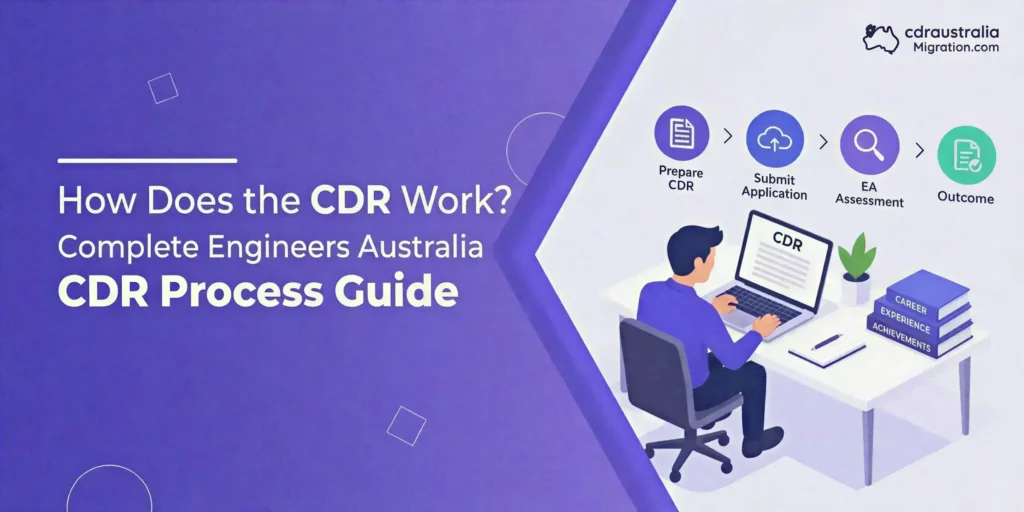
The CDR evaluation process evaluates your engineering knowledge through a step-by-step submission workflow:

Understanding how these stages connect ensures you avoid unnecessary delays or formal requests for information (RFIs) from Engineers Australia.
Who Needs the Engineers Australia CDR Pathway?
You will need to submit a CDR application if you meet the following conditions:
- You hold an engineering qualification from an institution that is not accredited under an recognized international agreement (Washington Accord, Sydney Accord, or Dublin Accord).
- Your qualification is from an accord-signatory nation, but was completed before the country became a signatory or during a non-accredited timeframe.
- You are applying under a specific ANZSCO Occupation Code that requires customized demonstration of practical competency.
CDR Requirements
To build a compliant application, you must gather personal identification, academic history, and technical portfolio components.
| Component / Requirement | Description & Details |
| Identity Documents | Valid passport, current passport-sized photo, official name-change documents (if applicable), and updated Curriculum Vitae (CV/Resume). |
| Academic Records | Degree certificates, official academic transcripts, and course completion letters. (Official English translations are needed for non-English documents). |
| English Language Proficiency | Valid test scores from IELTS (Academic or General), PTE Academic, or TOEFL iBT. Exemptions apply to native English speakers from specified countries. |
| CPD (Continuing Professional Development) | A concise, single-page summary list showing how you have kept your engineering knowledge up to date post-graduation. |
| 3 Career Episodes | Three detailed narrative essays describing distinct engineering projects or tasks where you personally applied your engineering skills. |
| Summary Statement | A structured cross-referencing document that links specific paragraphs in your Career Episodes to Engineers Australia’s competency units. |
| Employment Evidence | Reference letters, pay slips, tax returns, and official job descriptions if claiming work experience or writing episodes based on professional roles. |
CDR Assessment Process Explained Step by Step
Let us break down the CDR process Engineers Australia specifies into 9 sequential steps.
Step 1: Determine Your CDR Pathway
Before writing, confirm which occupational category matches your qualification:
- Professional Engineer (4-year Bachelor degree equivalent)
- Engineering Technologist (3-year Bachelor degree equivalent)
- Engineering Associate (2-year Advanced Diploma or Associate degree equivalent)
- Engineering Manager (Requires extensive leadership experience in engineering)
Match your background to the appropriate ANZSCO Code listed on the official skilled occupation list.
Step 2: Create and Prepare Your Engineers Australia Application
Register for a unique Engineers Australia ID (EA ID) on the official online portal. Verify your personal details, collect identity proof, update your CV to reflect accurate timelines, and prepare official English test results.
Step 3: Prepare Your CPD
The Continuing Professional Development (CPD) statement demonstrates your ongoing technical growth. Format it as a simple list covering:
- Post-graduate academic studies
- Short courses, seminars, and workshops attended
- Technical conferences and presentations
- Reading of engineering journals or literature
- Volunteer work in technical societies
Step 4: Write Your Career Episodes
The three Career Episodes form the core of your report. Each episode focuses on a specific engineering project or period of activity.
- Format: Written in first-person singular narrative (“I designed,” “I calculated,” “I evaluated”).
- Word Count: Generally 1,000 to 2,500 words per episode.
- Structure:
- Introduction: Chronology, dates, location, organization, and role.
- Background: Context of the overall project, objectives, and organizational chart showing your position.
- Personal Engineering Activity: Technical work, calculations, software used, challenges encountered, design choices, and problem-solving steps.
- Summary: Overview of project outcomes and your specific contributions.
Step 5: Prepare the Summary Statement
The Summary Statement bridges your Career Episodes and Engineers Australia’s competency standards.
It lists the competency elements for your occupational category and requires you to cross-reference paragraph numbers from your Career Episodes (e.g., CE 1.2, CE 2.4) as evidence. Only one Summary Statement is required for all three Career Episodes combined.
Step 6: Review Your Complete CDR
Conduct a thorough quality review:
- Check that all narrative paragraphs are clearly numbered (e.g., Section 1.1, Section 1.2).
- Ensure technical terms, project outcomes, and dates are consistent across your CV, Career Episodes, and reference letters.
- Check that no content is copied or plagiarized.
Step 7: Submit Your CDR Application
Log into the Engineers Australia online portal, select the Migration Skills Assessment (MSA) service, upload your documents in PDF format, pay the required assessment fee, and submit. You can also opt for Fast Track processing if available at the time of submission.
Step 8: Engineers Australia Evaluates Your CDR
An allocated Engineers Australia assessor will review your complete dossier:
- Verify document authenticity and English language proficiency.
- Check for plagiarism using automated software.
- Evaluate whether your Career Episodes demonstrate the required technical competencies for your nominated occupation.
Step 9: Receive Your Outcome
Once evaluation is complete, you will receive an official Migration Skills Assessment Outcome Letter via the portal.
What Happens After You Submit Your CDR?
After submitting your application through the portal, one of three main outcomes will occur:
- Successful Assessment Outcome: You receive a formal letter confirming that your engineering qualifications and competencies match your nominated ANZSCO occupation. This letter can be submitted to the Department of Home Affairs as part of your Australian skilled visa application.
- Request for Further Information (RFI): If documents are missing, formatting is incorrect, or additional evidence is needed, the assessor will issue an RFI. You will be given a specific timeframe to submit the requested clarification.
- Unsuccessful Assessment Outcome / Reassignment: If your report fails to meet standards or contains copied content, the assessor may reject the application or suggest down-grading your occupational category (for example, assessing a Professional Engineer applicant as an Engineering Technologist).
How Engineers Australia Evaluates a CDR
Engineers Australia uses a competency-based evaluation framework designed to assess your engineering knowledge, problem-solving skills, and execution abilities.
Key evaluation criteria include:
- Personal Contribution: The assessor evaluates what you did individually, not what your team achieved overall.
- Technical Engineering Judgement: The depth of technical analysis, design calculations, code application, and problem resolution demonstrated in your writing.
- Authenticity and Originality: Complete original work supported by verifiable documentary evidence (drawings, reports, employment references).
- Communication Skills: Your ability to present complex technical topics clearly in written English.
How Long Does the CDR Process Take?
The duration of the CDR application process depends on two distinct phases:
Phase 1: Preparation Time (2 to 8 Weeks)
This includes gathering documents, preparing academic transcripts, obtaining employer reference letters, drafting three Career Episodes, and mapping the Summary Statement.
Phase 2: Engineers Australia Processing Time
- Standard Assessment: Typically takes anywhere from 8 to 12 weeks, depending on application volume.
- Fast Track Service: Processing usually occurs within 15 to 20 business days when selected at submission.
Common CDR Mistakes to Avoid
A single mistake can result in processing delays, requests for information, or application rejection. Avoid these common errors:
- Plagiarism and Unoriginal Content: Copying content from sample CDRs, websites, or AI-generated templates can result in rejection and a multi-year ban from Engineers Australia.
- Focusing on Team Achievements: Writing “We designed the beam” instead of “I performed the structural calculations for the beam” obscures your individual contribution.
- Lack of Technical Detail: Writing brief, high-level job descriptions rather than detailing specific calculations, engineering software, parameters, and design decisions.
- Poor Summary Statement Mapping: Pointing competency elements to irrelevant paragraphs in your Career Episodes.
- Inconsistent Timelines: Submitting a CV that contradicts dates in reference letters or Career Episodes.
- Ignoring Formatting Guidelines: Failing to follow paragraph numbering rules or word count recommendations specified in the MSA Booklet.
Tips for a Successful CDR Submission
To improve your chances of a positive skills assessment outcome:
- Use Genuine Personal Projects: Choose real academic or work projects where you made significant, verifiable technical contributions.
- Write in First-Person Narrative: Consistently use “I” statements (“I calculated,” “I analyzed,” “I drafted”) to keep the focus on your personal actions.
- Highlight Technical Problem-Solving: Detail a specific technical problem you faced, the engineering principles you applied, and how you verified your solution.
- Keep Documents Consistent: Ensure dates, job titles, project details, and company names match across your CV, employment references, and Career Episodes.
- Double-Check Competency Mapping: Review your Summary Statement line-by-line to verify that every cited paragraph contains the relevant evidence.
- Proofread Thoroughly: Review your work for clear grammar, professional tone, and logical structure.
CDR vs. Other Engineers Australia Assessment Pathways
Engineers Australia offers multiple assessment pathways depending on where you obtained your degree.
| Assessment Pathway | Target Applicants | Primary Evidence Required | General Process |
| Competency Demonstration Report (CDR) | Graduates with non-accredited or overseas degrees from non-accord nations. | Academic transcripts, CV, CPD, 3 Career Episodes, Summary Statement. | Custom portfolio evaluation assessing individual competencies. |
| Australian Qualification Pathway | Graduates holding accredited engineering degrees from Australian universities. | Official Australian university transcript and degree testamur. | Streamlined qualification verification. |
| Washington Accord Pathway | Graduates holding accredited professional engineering degrees from Washington Accord countries. | Accredited degree certificate, transcript, and syllabus matching. | Qualification verification via international accord agreement. |
| Sydney / Dublin Accord Pathways | Graduates with accredited technologist (Sydney) or associate (Dublin) qualifications. | Accredited diploma/degree certificates from signatory nations. | Qualification recognition under accord standards. |
Frequently Asked Questions About How the CDR Works
How do I apply for a CDR assessment?
You apply online through the Engineers Australia portal. Create an account, fill out the Migration Skills Assessment form, upload your PDF documents (CPD, Career Episodes, Summary Statement, degree records, identity proof, CV), pay the assessment fee, and submit.
What documents are required for a CDR?
You need your passport, passport photo, updated CV, English test results (IELTS/PTE/TOEFL unless exempt), degree certificate, academic transcripts, CPD list, 3 Career Episodes, Summary Statement, and employment reference letters with pay evidence if claiming work experience.
How many Career Episodes are required?
Engineers Australia requires exactly three Career Episodes. Each episode must focus on a different engineering project or distinct period of engineering activity.
What is a Summary Statement ?
The Summary Statement is a cross-referencing document that maps specific competency elements (such as design skills, problem-solving, and professional ethics) to specific paragraphs within your three Career Episodes.
How does Engineers Australia evaluate a CDR?
Engineers Australia evaluates your CDR against defined competency standards for your engineering category. Assessors check for genuine personal engineering work, technical problem-solving, correct application of engineering concepts, original writing, and written English proficiency.
How long does the CDR assessment process take?
Preparation typically takes 2 to 8 weeks. Once submitted, standard Engineers Australia assessment processing generally takes 8 to 12 weeks, while Fast Track processing usually takes 15 to 20 business days. Check current timelines on the Engineers Australia website.
What happens after CDR submission?
After submission, your application enters the queue for review. An assessor will evaluate your file and either issue a positive outcome letter, issue a Request for Information (RFI) for additional details, or issue an unsuccessful outcome if requirements are not met.
Can I revise my CDR before submitting it?
Yes, you can edit and refine your CDR as much as needed prior to final submission on the Engineers Australia portal. However, once submitted and paid for, you cannot make changes unless requested by an assessor via an RFI.
What happens if my CDR assessment is unsuccessful?
If your assessment is unsuccessful, you will receive a notification detailing the reasons. You can apply for an informal review, lodge a formal appeal within specified timeframes, or re-apply after addressing the issues (such as revising weak episodes or providing missing work evidence).
Final Thoughts
Navigating the Engineers Australia CDR process requires careful preparation, clear technical documentation, and compliance with official migration skills assessment standards. By selecting genuine engineering projects, emphasizing your personal technical contributions, mapping your competencies thoroughly in the Summary Statement, and avoiding plagiarism, you establish a solid foundation for a positive assessment outcome.
If you need expert guidance on preparing, reviewing, or refining your Competency Demonstration Report, our team at CDR Australia Migration provides professional support tailored to internationally qualified engineers seeking Australian migration.