
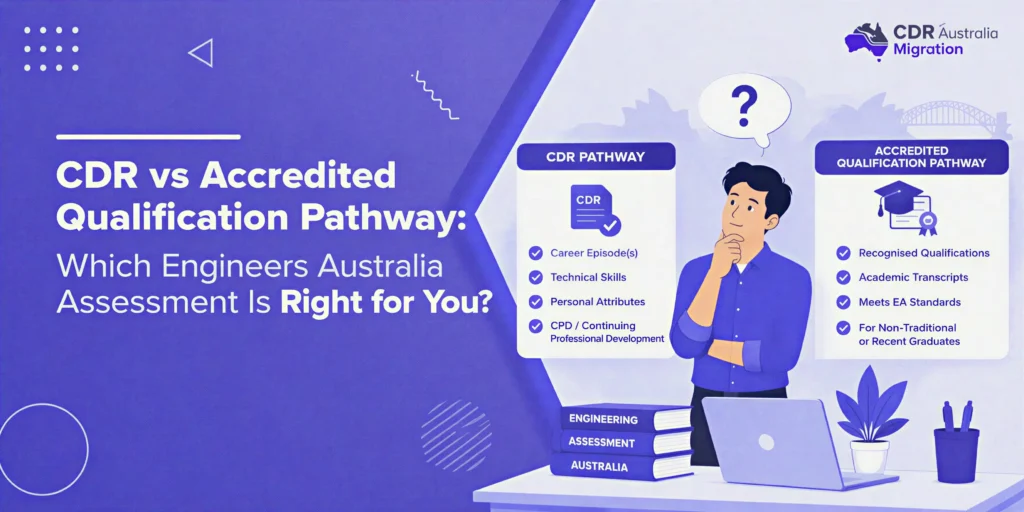
Engineers Australia offers two primary routes for migration skills assessments: the Accredited Qualification Pathway and the Competency Demonstration Report (CDR) pathway. If your engineering degree is recognized under an international accord or directly accredited by Engineers Australia, your qualification pathway is straightforward.
However, if your degree was obtained from a non-accredited institution, you must demonstrate your engineering knowledge and practical experience through the CDR pathway Engineers Australia sets out.
This guide provides a comprehensive comparison of both pathways, detailing eligibility rules, document requirements, and step-by-step procedures to help you identify the right stream for your migration journey regarding CDR vs Accredited Qualification Pathway.
What Is the Engineers Australia CDR Pathway?
The Competency Demonstration Report (CDR) pathway is a technical assessment process designed for engineers holding non-accredited or unrecognized qualifications. CDR stands for Competency Demonstration Report, a detailed portfolio of documents where you showcase how your engineering knowledge, practical skills, and professional experience match Australian standards.
Engineers Australia relies on the Engineers Australia CDR pathway to assess whether an applicant’s undergraduate qualification and post-graduate engineering experience meet the core competencies required for practice in Australia. Rather than focusing solely on the name or syllabus of your university degree, the CDR pathway for engineers evaluates how you have applied engineering principles, solved complex technical problems, and adhered to professional safety standards in real-world scenarios.
Commonly used by international engineering graduates from countries outside major educational accords, this pathway offers a clear route to benchmark engineering qualifications against Australian standards.
What Is the Accredited Qualification Pathway?
The Accredited Qualification Pathway is a streamlined skills assessment stream for applicants holding an accredited engineering qualification. In this context, “accredited” means that the engineering program has been formally evaluated and recognized either directly by Engineers Australia or through an international engineering agreement.
Engineers Australia recognizes qualifications under three key international agreements, known collectively as the International Engineering Alliance (IEA) Accords:
- Washington Accord: Applies to professional engineering degree programs (typically 4-year Bachelor of Engineering degrees).
- Sydney Accord: Applies to engineering technologist degree programs (typically 3-year Bachelor of Engineering Technology degrees).
- Dublin Accord: Applies to engineering technician qualifications (typically 2-year Associate Degrees or Advanced Diplomas in engineering).
If your degree was completed at an accredited institution, in an accredited country, and during or after the specific year the country became a signatory to the accord, Engineers Australia recognizes your academic qualification directly. You generally do not need to submit written career episodes or a summary statement under this stream.
Note: Holding an engineering degree from an accord-signatory country does not automatically mean your specific program is accredited. Accreditation depends on the exact university, program title, and the year you graduated.
CDR vs Accredited Qualification Pathway: Key Differences
To help you compare both streams at a glance, the table below breaks down the structural differences between the CDR pathway and the Accredited Qualification Pathway.
| Factor | CDR Pathway | Accredited Qualification Pathway |
|---|---|---|
| Qualification Recognition | Designed for non-accredited or unrecognized qualifications. | Designed for qualifications formally recognized under the Washington, Sydney, or Dublin Accords (or Australian accredited programs). |
| Typical Applicant | Internationally educated engineers whose degrees are not covered by an international agreement. | Engineering graduates from accredited Australian universities or accord-signatory institutions. |
| Competency Evidence | High focus on written evidence demonstrating practical application of engineering competencies. | High focus on institutional accreditation and official academic transcripts. |
| CDR Requirement | Mandatory (3 Career Episodes, Summary Statement, CPD list). | Not Required. |
| Academic Documentation | Degree certificate, transcripts, and syllabus details if requested. | Degree certificate and official academic transcripts showing accord-level accreditation. |
| Assessment Approach | Comprehensive assessment of individual project work, technical tasks, and personal contribution. | Fast-tracked verification of degree accreditation status and academic history. |
| Preparation Complexity | Requires substantial time to draft, review, and finalize original engineering narratives. | Low complexity; primarily involves gathering administrative and academic documents. |
| Suitability for Non-Accredited Qualifications | Fully Suitable; explicitly created to assess non-accredited engineering degrees. | Unsuitable; requires full accreditation under a recognized framework. |
| Migration Relevance | Provides a Migration Skills Assessment outcome letter for Department of Home Affairs visa applications. | Provides a Migration Skills Assessment outcome letter for Department of Home Affairs visa applications. |
Who Needs a CDR?
You will need to submit a CDR if you want to apply for an Australian skilled migration visa as an engineer and meet any of the following conditions:
- Your degree is non-accredited: You obtained your engineering qualification from an overseas university that is not accredited by an accord signatory (Washington, Sydney, or Dublin Accord).
- Your program was completed before accreditation: You graduated from an institution in an accord country before that country or specific program gained official signatory status.
- Your engineering category is not covered by the accord: You hold a qualification that does not align directly with the accord level required for your nominated occupational category in Australia.
- Engineers Australia explicitly directs you to apply via a CDR: After an initial review or preliminary check, Engineers Australia advises you to demonstrate your competency through the CDR assessment pathway.
Before assuming you need a CDR, check your qualification against the Engineers Australia database or the official International Engineering Alliance list of accredited programs.
CDR Pathway Eligibility
To be eligible for the CDR assessment pathway, you must meet structural academic and English language benchmarks set by Engineers Australia.
1. Academic Qualification
You must hold a formal engineering qualification (such as an undergraduate degree, diploma, or higher education qualification) that aligns with one of Engineers Australia’s four occupational categories:
- Professional Engineer (equivalent to an Australian 4-year Bachelor of Engineering degree)
- Engineering Technologist (equivalent to an Australian 3-year Bachelor of Engineering Technology degree)
- Engineering Associate (equivalent to an Australian 2-year Diploma or Advanced Diploma in Engineering)
- Engineering Manager (requires a degree in an engineering discipline along with extensive high-level managerial experience)
2. English Language Proficiency
Applicants applying through the CDR pathway must demonstrate English language competence by achieving minimum required scores in tests such as IELTS, PTE Academic, or TOEFL iBT.
Exemptions from English language testing generally apply to native English speakers who hold passports from specific countries (such as Australia, the UK, the US, Canada, New Zealand, or Ireland) or applicants who have completed an Australian undergraduate engineering degree or a PhD program at an Australian university (subject to current EA guidelines).
3. Alignment with Nominated Occupation
Your academic qualification, combined with your technical narratives in your CDR, must closely match the tasks and skills defined in the ANZSCO (Australian and New Zealand Standard Classification of Occupations) code for your nominated engineering discipline.
CDR Pathway Requirements
The primary requirement of the Engineers Australia migration pathway via a CDR is assembling a comprehensive dossier. This portfolio consists of standard identity credentials, academic documentation, and original written work.
An Engineers Australia CDR pathway application requires the following core components:
- Personal Identification Documents: Passport bio-data page, official name-change documentation (if applicable), and a recent passport-style photograph.
- English Language Test Results: Valid test results (IELTS, PTE Academic, or TOEFL iBT) sent directly or uploaded as required.
- Academic Credentials: Official degree certificates, complete academic transcripts, and curriculum descriptions (if required for non-standard courses).
- Curriculum Vitae (CV) / Resume: A detailed record of your education and employment history, formatted according to Engineers Australia recommendations.
- Continuing Professional Development (CPD) Statement: A list formatted in chronological order outlining how you have kept your engineering knowledge up to date after graduation (e.g., short courses, industry workshops, technical literature, and postgraduate study).
- Three Career Episodes: Written narratives detailing specific engineering projects or tasks from your studies or employment.
- Summary Statement: A cross-referenced grid linking the paragraphs in your Career Episodes to the specific competency elements required for your nominated occupational category.
- Evidence of Employment: Official employment reference letters, pay slips, tax documentation, and social security contributions if you claim work experience or base your Career Episodes on paid employment.
What Is Involved in a CDR Pathway Application?
Preparing and submitting a CDR application requires careful planning. Follow these steps to prepare your submission effectively:
- 1Determine Your Occupational Category: Review Engineers Australia’s four occupational categories (Professional Engineer, Engineering Technologist, Engineering Associate, Engineering Manager) and select the ANZSCO code that best fits your academic background and work history.
- 2Check Eligibility and Pathway Requirements: Search the International Engineering Alliance (IEA) databases to confirm that your program is non-accredited. Verify current English test score benchmarks and gathering rules on the Engineers Australia portal.
- 3Gather Administrative and Academic Records: Obtain official, high-resolution scans of your degree certificate, academic transcripts, passport bio-data page, English language test results, and an updated engineering CV.
- 4Draft Your Continuing Professional Development (CPD): Prepare a clear, one-page chronological list summarizing post-graduation learning activities, such as seminars, conferences, technical reading, software courses, or workplace training modules.
- 5Write Your Three Career Episodes: Write three distinct Career Episodes based on major engineering projects from your university coursework or professional work history. Structure each episode into standard sections: Introduction, Background, Personal Engineering Activity, and Summary. Ensure you write in the active voice using first-person singular pronouns (“I designed,” “I calculated,” “I evaluated”).
- 6Complete the Summary Statement: Map your Career Episodes against the competency units outlined in the Engineers Australia Migration Skills Assessment (MSA) Booklet. Fill in the Summary Statement template by identifying the exact paragraph numbers where each competency element is demonstrated.
- 7Review for Originality and Compliance: Review all written sections to confirm they accurately reflect your personal work. Engineers Australia strictly uses automated software to check for plagiarism, generic templates, or AI-generated content.
- 8Submit via the Engineers Australia Online Portal: Create an account on the Engineers Australia online portal, select the CDR Assessment pathway (and relevant add-ons such as Relevant Skilled Employment or Overseas PhD assessments), upload your PDF files, and pay the assessment fee.
- 9Respond to Requests for Further Information (RFI): If an assessor requires additional documentation or clarification regarding your Career Episodes, submit the requested details within the specified timeframe.
- 10Receive Your Assessment Outcome: Once processing is complete, download your official Migration Skills Assessment outcome letter from the online portal.
Engineers Australia Skills Assessment Pathway for Migration
Understanding where the skills assessment fits into the broader Australian immigration framework is essential for planning your journey.
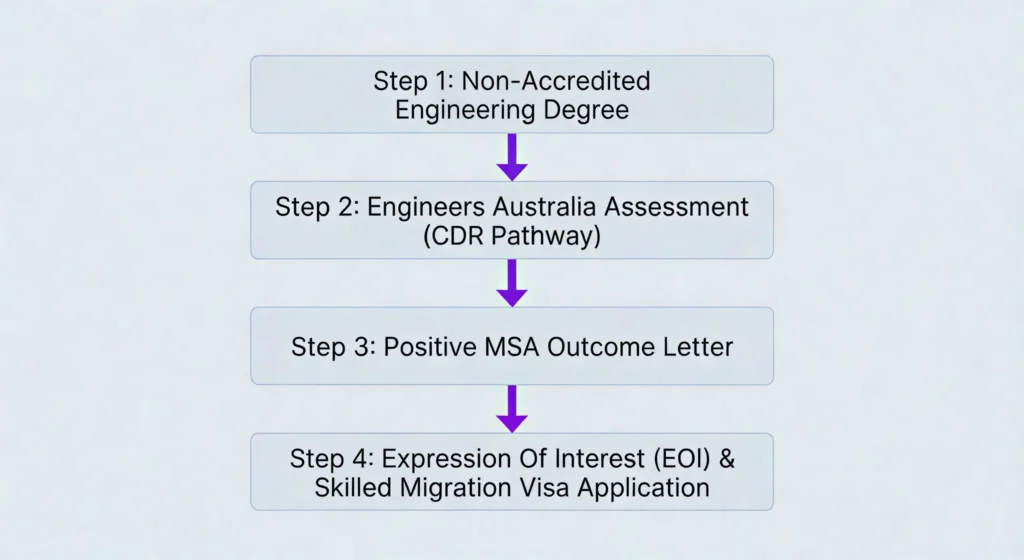
- Role of Engineers Australia: Engineers Australia is the designated assessing authority for engineering occupations in Australia. Its role is solely technical, it evaluates whether your qualification and competencies match Australian engineering standards for your nominated occupation.
- Role of the Department of Home Affairs: The Australian Department of Home Affairs handles all visa applications, immigration policy, points tests, character/health checks, and permanent residency decisions.
A positive skills assessment outcome from Engineers Australia confirms that your engineering qualification is recognized for skilled migration purposes. However, a positive assessment does not guarantee visa grant or permanent residency (PR). You must still meet all general visa eligibility criteria established by the Department of Home Affairs, including age limits, points thresholds, state nominations, and health requirements.
CDR Pathway for Engineers With a Non-Accredited Engineering Qualification
Holding a non-accredited engineering qualification does not reflect negatively on your abilities or career accomplishments. It simply means that your degree program has not been evaluated under a recognized international agreement like the Washington Accord.
Because Engineers Australia cannot automatically verify non-accredited syllabus contents across international institutions, the CDR process acts as an alternative benchmark. It allows you to present individual evidence demonstrating that you possess the professional knowledge, design capabilities, risk management skills, and ethical standards expected of an engineer in Australia.
When preparing a CDR with a non-accredited degree:
- Focus heavily on the personal technical contributions you made during specific projects.
- Clearly explain the engineering principles, calculations, software tools, and design standards you applied.
- Avoid focusing solely on team outcomes; assessors evaluate your specific engineering competence rather than general group performance.
Which Engineers Australia Assessment Pathway Is Right for You?
Use this decision-making framework to determine which pathway aligns with your background:
Consider the Accredited Qualification Pathway if:
- Your degree program is listed as fully accredited under the Washington Accord, Sydney Accord, or Dublin Accord.
- Your graduation date falls within the official accreditation period listed for your specific institution.
- Your qualification was awarded by a recognized Australian university program accredited by Engineers Australia.
Consider the CDR Pathway if:
- Your qualification was obtained in a country that is not an accord signatory.
- Your degree program is not accredited by the relevant national engineering body, even if your country is a signatory.
- You graduated before your country or program became an accord signatory.
- You hold an unconventional or non-standard engineering degree that requires custom proof of professional competency.
If you are unsure of your qualification status, verify your university details against the official IEA Accord database or consult Engineers Australia’s online migration resources before starting your application.
Common Mistakes Applicants Make When Choosing the CDR Pathway
Avoiding common application errors can save time and prevent assessment delays:
- Assuming Every Overseas Degree Requires a CDR: Applying through the CDR pathway when your degree is actually accredited under the Washington Accord can lead to unnecessary preparation work and extra costs. Always check accord databases first.
- Assuming All Overseas Degrees Are Automatically Recognized: Assuming your qualification is automatically recognized without verifying official accord databases or program start dates can result in application rejection.
- Selecting the Incorrect ANZSCO Category: Applying under an occupational category (e.g., Professional Engineer vs. Engineering Technologist) that does not match your degree level or career history can lead to a negative assessment outcome.
- Copying Content from Templates or AI Tools: Submitting Career Episodes copied from online samples, generic templates, or generated by AI tools triggers plagiarism flags. Engineers Australia strictly enforces zero-tolerance policies regarding plagiarized or non-original submissions.
- Focusing on Team Achievements Instead of Personal Actions: Writing “we designed” or “the company built” instead of “I calculated,” “I analyzed,” or “I specified” makes it difficult for assessors to evaluate your individual engineering contributions.
- Neglecting the Summary Statement: Treating the Summary Statement as an afterthought rather than carefully cross-referencing specific paragraphs in your Career Episodes can lead to requests for revisions.
- Confusing the Skills Assessment with a Visa Application: Treating an Engineers Australia assessment outcome as a visa grant can result in missed immigration deadlines or incorrect point score calculations.