
If you have worked across diverse domain areas, held multiple job titles, or transitioned between hands-on engineering, management, and technical consulting, figuring out CDR project selection can feel like trying to solve a complex system of differential equations without a formula sheet. Selecting the wrong engineering projects can lead to disastrous outcomes: formal rejections, delayed applications, requests for additional information (RFI), or an assessment under an ANZSCO code lower than your qualifications.
This comprehensive, step-by-step master guide provides detailed CDR project selection tips to help you identify, map, structure, and write about the ideal engineering projects when you have multiple roles in your career history.
What is a Competency Demonstration Report (CDR)?
The CDR is the technical pathway through which international engineers prove that their qualifications, technical skills, and professional experience match the stringent standards set for Australian engineering professions. The primary components of a CDR include:
- Continuing Professional Development (CPD): A list showing how you keep your engineering knowledge updated.
- Three Career Episodes (CEs): Detailed narrative accounts focusing on specific periods of engineering activity or specific projects.
- Summary Statement: An analytical matrix that maps elements of competency to specific paragraphs within your Career Episodes.
What Engineers Australia Evaluates in a CDR Project
Engineers Australia assesses your qualifications and work experience against standardized competency profiles tailored to specific occupational categories:
- Professional Engineer (Focus on complex engineering problems, innovation, system design, and synthesis).
- Engineering Technologist (Focus on applying established engineering technologies, technical optimization, and design adaptation).
- Engineering Associate (Focus on procedural application, operational support, and technical maintenance).
- Engineering Manager (Focus on high-level strategy, resource allocation, and technical leadership).
Regardless of your job title, whether you were an Intern, Junior Engineer, Lead Site Supervisor, or Operations Director, EA evaluates your personal technical contribution as an engineer, not just the overall achievements of your team or company.
Key CDR project requirements include:
- Direct Application of Engineering Knowledge: Applying foundational engineering principles, calculations, software simulation tools, and recognized design methods.
- Personal Accountability: Using clear “I” statements (e.g., “I calculated,” “I designed,” “I modeled,” “I troubleshot”) rather than collective “we” statements (“We built,” “Our team developed”).
- Problem-Solving & Innovation: Demonstrating how you personally identified complex technical problems, analyzed underlying causes, and formulated technical solutions.
- Strict Alignment with ANZSCO: Demonstrating competencies that map directly to the official unit tasks of the specific ANZSCO occupation code you are applying under.
CDR Australia Migration
can provide a clear, customized roadmap for your domain.
The Complexities of Multiple Roles in CDR Project Selection
Having held multiple positions throughout your engineering career is a major professional asset, but it introduces unique hurdles when selecting CDR career episode topics.
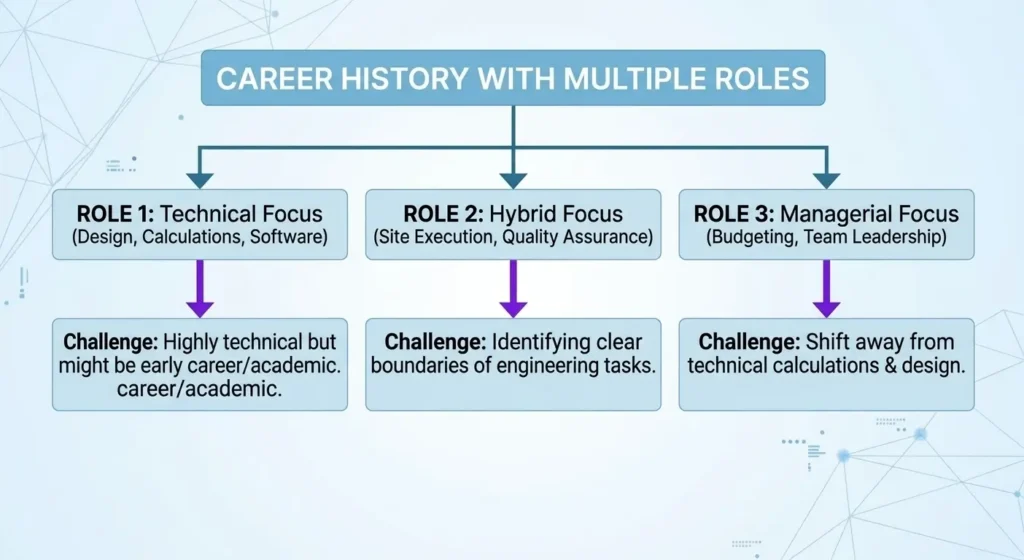
When candidates have multiple roles, they usually face four major obstacles:
1. The “Managerial Shift” Trap
As engineers progress, they naturally take on management responsibilities, budgeting, procurement, resource allocation, and team coordination. However, Engineers Australia evaluates technical engineering competencies.
If you write a Career Episode entirely about managing schedules and leading site safety meetings without explaining the technical formulas, design reviews, or engineering calculations you executed, EA may deem the episode non-compliant.
2. Disconnected ANZSCO Codes
You might have worked as a Software Test Engineer in Role 1, a Systems Analyst in Role 2, and a Technical Consultant in Role 3. If you apply under the ANZSCO code for Developer Programmer or Electrical Engineer, you must carefully pick projects across these roles that highlight code development, filtering out unrelated duties.
3. Dilution of Personal Contribution (“We” vs. “I”)
In senior or hybrid roles, work is collaborative. When reviewing past projects, applicants often fall into the habit of describing high-level organizational success rather than their personal, granular actions.
4. Fragmented Project Scope
In fast-paced consulting or multi-disciplinary environments, an engineer might handle 20 small tasks over two years rather than one large multi-month project. Choosing how to group these mini-tasks without making your report look fragmented requires deliberate planning.
Step-by-Step Guide: How to Choose CDR Projects When You Have Multiple Roles
Follow this structured framework to make choosing projects for CDR efficient, objective, and compliant.
Step 1: Map Your Career History Against ANZSCO Descriptors
Start by downloading the official ANZSCO occupation guidelines for your target engineering title (e.g., Civil Engineer 233211, Mechanical Engineer 233512, Telecommunications Engineer 263311).
- Create a matrix listing every project you worked on across all past and current roles.
- In the adjacent columns, list the official ANZSCO unit tasks for your nominated occupation.
- Mark checkmarks where your personal duties on a project overlap with ANZSCO requirements.
Step 2: Audit Projects for Technical Substance
Not all engineering projects are equal in the eyes of EA. Audit your shortlist against three criteria:
- Calculations: Did you personally perform structural, thermal, electrical, fluid, or algorithmic calculations?
- Software Tools: Did you use recognized engineering software (e.g., AutoCAD, ETABS, MATLAB, ANSYS, Revit, SolidWorks, Python, Primavera)?
- Standards & Codes: Did you apply specific national or international standards (e.g., AS/NZS, ASME, Eurocodes)?
A project from an early-career Junior Engineer role where you executed structural stress calculations using FEA software is far more valuable for a CDR than a recent project where you managed project schedules and budgets as a General Manager.
Step 3: Ensure Diversity Across Your 3 Career Episodes
Your CDR requires three separate Career Episodes spanning different aspects of your engineering career. Having multiple roles works to your advantage here because it lets you present a well-rounded technical portfolio:
- Career Episode 1 (Deep Design & Analysis): Choose a project centered on design, simulation, and theoretical calculations. This is often sourced from a technical design role or a comprehensive academic thesis project.
- Career Episode 2 (Execution, Testing & Problem Solving): Choose a project showcasing hands-on implementation, field troubleshooting, quality testing, or commissioning.
- Career Episode 3 (Complex Project Integration & Innovation): Showcase an advanced project from a higher-level role, keeping the narrative focused strictly on your high-level engineering decisions, system integration, and risk mitigation.
How Engineers Australia verifies CDR projects for skill assessment.
Step 4: Isolate Engineering Contributions from Non-Technical Roles
If your primary experience is in a managerial, commercial, or hybrid role, filter your project choices by asking:
- What specific technical failure or design bottleneck did I personally step in to solve?
- What engineering calculations did I review, modify, or approve?
- What technical criteria did I set during equipment selection or design optimization?
Step 5: Verify Supporting Documentation Availability
Engineers Australia can request evidence of your employment and project work. Before finalizing your project choices, confirm that you have access to:
- Project design logs, calculation sheets, or simulation reports.
- Official job descriptions, offer letters, and promotion notices reflecting your roles.
- Reference letters from supervisors or managers confirming your technical involvement.
CV guidelines according to Engineers Australia.
Detailed Role-by-Role Project Selection Strategy
Here is an expanded matrix showing how to select the best projects for CDR based on specific career transitions:
| Previous Role → Current/Recent Role | Technical Challenge | Recommended CDR Project Selection Strategy | Ideal CDR Project Ideas |
|---|---|---|---|
| Site Engineer → Project Manager | Shift from hands-on engineering to project execution and budgeting. | Select projects where you were personally involved in technical site adjustments, foundation load checks, design alterations, or safety engineering. | • Re-engineering a foundation design due to unexpected soil conditions. • Commissioning heavy industrial HVAC systems. • Structural retrofitting of an existing commercial building. |
| Design Engineer → Technical Sales / Consultant | Shift from core design work to client relations and business development. | Select projects where you performed client-facing engineering feasibility studies, custom technical design adaptation, or load calculations. | • Custom design of industrial water treatment systems based on client specs. • Solar PV plant capacity modeling and grid connection studies. • Electrical substation control panel design. |
| R&D / Academic → Industry Engineer | Academic projects may seem theoretical or lack full industrial application context. | Combine academic research with industry implementation. Highlight rigorous mathematical modeling, prototype development, and experimental validation. | • Design and FEA simulation of lightweight automotive suspension components. • Development of an IoT-based structural health monitoring algorithm. • CFD modeling of fluid flow in pipe networks. |
| Quality Assurance (QA) → Operations Lead | Roles are heavily process-focused with limited direct design work. | Focus on root-cause failure analysis, material testing, non-destructive testing (NDT), and redesign recommendations based on quality data. | • Investigating fatigue failure in industrial machinery components. • Redesigning a manufacturing pipeline to reduce defect rates using 6-Sigma. • Validating pressure vessel integrity under high-temperature loads. |
Structuring Your Career Episode Narrative
Once you have selected your three projects, you need to write them according to EA’s standardized format. Each Career Episode should range between 1,000 and 2,500 words and strictly follow this 4-part structure:
1. Introduction
State the project title, timeline, location, company name, and the role you held. Keep this strictly factual.
Example: “This career episode details my personal involvement in the structural design and analysis of a 12-story commercial building project in Sydney, Australia, executed while I was employed as a Structural Design Engineer at XYZ Engineering Consultants between March 2023 and November 2023.”
2. Background
Provide context for the project, its total scale, its overall objectives, and your specific location within the organizational hierarchy.
- Detail the nature and goals of the project.
- Include an organizational chart showing your position, emphasizing who you reported to and who reported to you.
- State your assigned personal responsibilities.
3. Personal Engineering Activity
This is the core of your episode. It must focus entirely on your personal actions using “I” statements.
- Engineering Calculations: Detail the mathematical models, formulas, and stress/load analyses you conducted.
- Software Tools Applied: Describe how you used tools like MATLAB, ETABS, Revit, or Python to model systems or analyze data.
- Problem-Solving: Detail specific technical problems encountered during the project and how you personally engineered a solution.
- Codes & Standards: List the specific regional or international technical standards you referenced.
- Safety & Environment: Outline how you addressed environmental impacts, occupational health and safety (OHS) regulations, and risk management protocols.
4. Summary
Wrap up the episode by summarizing the outcome of the project and your personal contributions.
- State whether the project met its goals and deadlines.
- Highlight how your technical design or solution contributed to the overall success of the project.
CDR preparation guidelines.
Practical Examples: Good vs. Bad Project Framing
To highlight the difference between compliant and non-compliant descriptions, review these comparative examples drawn from candidates with multiple roles:
Example 1: Project Manager Role (Civil Engineering)
“As the Project Manager, I led a team of 15 engineers to build a 50-meter concrete bridge. I allocated the $2M budget, organized weekly progress meetings, managed subcontractors, and ensured the project was completed on time and under budget.”
“While managing the bridge construction project, I personally evaluated the structural integrity of the abutments due to unexpected soil displacement.”
Example 2: Systems Consultant Role (Electrical Engineering)
“I worked as a Consultant where I pitched electrical control systems to industrial clients. We presented system options, closed contracts, and handed off implementation plans to our technical site team.”
“As a Technical Systems Consultant, I conducted comprehensive electrical load calculations and harmonic disturbance analyses for an industrial manufacturing facility. I designed the schematic diagrams for a 415V switchboard in AutoCAD and selected circuit breakers and protection relays per AS/NZS 3000 standards.”
Common Pitfalls to Avoid in CDR Project Selection
Even with solid experience across multiple roles, candidates often make avoidable mistakes during CDR project selection.
1. Over-Emphasizing Management over Technical Application
Never let team management, client communication, or financial management consume more than 10-15% of your Career Episode word count. The remaining 85-90% must focus on technical problem-solving, engineering analysis, calculations, design, and software modeling.
2. Lack of Technical Depth and Specifics
Avoid vague assertions like “I performed calculations and the design was approved.” Instead, detail the specifics: “I calculated the maximum bending moment and shear force on the structural steel beams using formulas and validated the results in Space Gass software against AS 4100 guidelines.”
3. Excessive Overlap Between Episodes
Each of your three Career Episodes should highlight different skills, project scopes, or phases of the engineering lifecycle (e.g., Episode 1: Design/Analysis; Episode 2: Construction/Implementation; Episode 3: Testing/Optimization/System Maintenance). Selecting three projects that focus on the exact same task makes your report feel repetitive.
4. Mismatched Resume and Career Episode Data
Engineers Australia cross-checks your Career Episodes against your CV, reference letters, and LinkedIn profile. Ensure project dates, company names, job titles, and locations match exactly across all documents.
Frequently Asked Questions (FAQs)
1. Can I use projects from different job roles across my 3 Career Episodes?
Yes. Using projects from different roles is often recommended if it demonstrates a broader range of engineering competencies. Ensure that all selected projects clearly reflect the technical requirements of your single nominated ANZSCO occupation code.
2. What if my recent role is purely managerial with no hands-on technical work?
If your recent role is predominantly administrative or managerial, focus your CDR project selection on earlier roles where you performed hands-on technical work, design, analysis, or testing. Alternatively, pick specific instances in your managerial role where you made direct or designed solutions for unexpected site challenges.
3. Can I use academic projects if my professional experience spans multiple roles?
Yes. Engineers Australia permits academic projects (such as a Final Year Engineering Project, Master’s Thesis, or major university capstone project) for one or more career episodes. This is particularly helpful if your recent professional roles lacked pure design or technical calculation components.
4. How far back can I go when choosing engineering projects for a CDR?
There is no explicit time limit set by Engineers Australia regarding project age. However, selecting relatively recent projects (typically within the last 5 to 10 years) is ideal because supporting documentation, such as design logs, is much easier to retrieve and verify.
5. What if I worked on multiple small projects under a single role?
If you handled multiple small tasks under a single job title, select one or two major tasks that required significant engineering input and combine them into a single unified project narrative within one Career Episode. Avoid listing fragmented, unrelated mini-tasks.
6. Do I need to provide full engineering calculations and drawing attachments?
No, you do not need to attach your complete calculation sheets or CAD blueprints. However, you must describe the formulas, software tools, variables, standards, and outcome values directly within the body of your Career Episode text.
7. How do I handle confidential or proprietary information in my project selection?
If a project involved confidential client data, defense systems, or proprietary algorithms, you can substitute client names, specific geographic coordinates, or exact financial figures with generic labels (e.g., “Project Alpha,” “a major national telecom provider”). Make sure the core technical engineering methodologies remain clear and intact.