
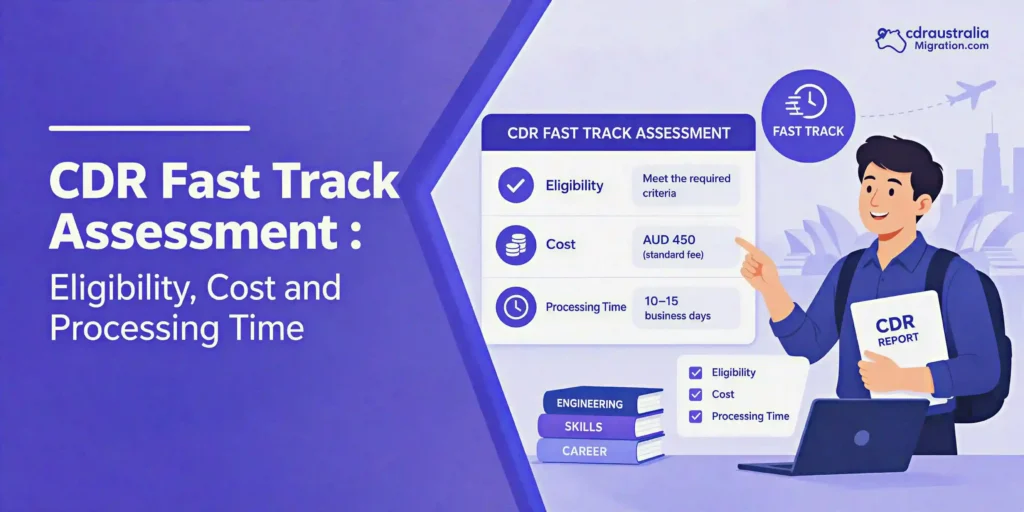
Engineers Australia offers a priority processing mechanism designed to expedite the initial administrative handling of your Migration Skills Assessment (MSA) application. For engineering professionals facing tight visa deadlines, approaching state nomination cut-offs, or point-score age thresholds, understanding how to utilize expedited processing effectively can make a measurable difference in timeline management.
In this guide, you will learn about the CDR Fast Track Assessment 2026 eligibility criteria, official 2026 fee structures, realistic processing timeframes, required documentation, and practical strategies to ensure your fast-track CDR application proceeds without avoidable delays.
What Is a CDR Fast Track Assessment?
A Competency Demonstration Report (CDR) is a technical portfolio that proves an applicant’s engineering knowledge, practical competencies, and workplace skills match Australian standards. Engineers Australia (EA) serves as the designated assessing authority for engineering occupations under Australia’s skilled migration framework.
A CDR fast track assessment is a premium, prioritized administrative service provided by Engineers Australia. Under standard processing, submitted applications enter a general queue and wait several months before being reviewed by a case officer. When you select the Engineers Australia fast track option, your file bypasses the general waiting queue and moves into a priority stream.
The key distinction between standard processing and a fast track CDR assessment lies in the assessor assignment time:
- Standard Processing: The application sits in a general queue until an assessor becomes available to open the file.
- Fast Track Processing: The application is guaranteed to be assigned to an assessor within a specified priority timeframe (typically 20 business days).
Applicants choose expedited processing primarily to synchronize their skills assessment with critical immigration benchmarks, such as Expression of Interest (EOI) submission rounds or subclass 485/189/190/491 visa planning.
Does Engineers Australia Offer Fast-Track CDR Assessment in 2026?
Yes, Engineers Australia actively offers the Engineers Australia fast track assessment service for Migration Skills Assessment applicants.
According to official 2026 Engineers Australia guidelines, selecting fast-track processing ensures your application is assigned to an assessor within 20 business days (approximately 4 calendar weeks) from the date of submission and payment.
Key Realities of the 2026 Fast-Track System
- Queue Priority: The fast-track service accelerates queue placement, not the depth or rigor of the evaluation.
- No Outcome Guarantees: Fast track does not guarantee an immediate positive outcome. The assessor must still verify that your qualifications, Career Episodes, Summary Statement, and employment evidence strictly adhere to the MSA Booklet requirements.
- Potential Extensions: If an assessor issues a Request for Information (RFI) due to missing documents, ambiguous employment reference letters, or unclear technical details, the overall processing clock pauses until you provide the requested response.
CDR Fast Track Assessment Eligibility
The fast-track processing option is open to any applicant applying for a Migration Skills Assessment through Engineers Australia, regardless of the specific qualification pathway.
Eligibility for fast-track processing requires:
- Applying under an eligible engineering occupation recognized by Engineers Australia (e.g., Professional Engineer, Engineering Technologist, Engineering Associate, or Engineering Manager).
- Possessing an active online account with Engineers Australia (EA ID).
- Choosing an eligible assessment pathway, including the Competency Demonstration Report (CDR) pathway, Washington Accord, Sydney Accord, Dublin Accord, or Australian Accredited Qualifications.
- Submitting the necessary supporting documents in the required formats.
- Paying the mandatory standard assessment fee plus the additional fast-track fee.
Opting for priority processing does not alter or relax the underlying competency criteria. Every CDR fast track assessment is measured against the exact same professional and technical standards as standard applications.
Who Should Consider Fast-Track Processing?
- Engineers with Imminent Visa Deadlines: Applicants whose age points will decrease soon or whose temporary visas are nearing expiration.
- Invitation Round Candidates: Individuals preparing for upcoming state or federal migration invitation rounds who require an outcome letter quickly.
- Decision-Ready Applicants: Candidates who have fully prepared, audited, and verified their CDR report, transcripts, and work references.
Who Should Avoid Rushing Their CDR Application?
- Applicants with Incomplete Documentation: Submitting an incomplete file under fast track wastes money because an RFI will immediately delay the file.
- Candidates with Weak Career Episodes: If your Career Episodes lack technical depth, contain plagiarized content, or fail to demonstrate personal design contributions, paying for fast track only accelerates an unfavorable outcome or an RFI.
- Applicants Needing English Test Results: Fast-track applications submitted without meeting mandatory English language proficiency requirements (where applicable) will be halted immediately.
CDR Fast Track Fee 2026
Engineers Australia charges an additional fee specifically for the fast-track service. This fee is added to your primary assessment cost (and any supplementary services like Relevant Skilled Employment or Overseas PhD assessments).
Fees vary depending on whether you reside inside Australia (inclusive of 10% Australian Goods and Services Tax – GST) or outside Australia (GST exempt).
(Note: Engineers Australia periodically updates its fee schedules. Figures shown represent official 2026 published baseline rates. Always verify current amounts directly on the official Engineers Australia website before submitting payment.)
The CDR fast track fee is non-refundable once application processing has commenced, regardless of whether your overall assessment outcome is positive, negative, or delayed by an RFI.
CDR Fast Track Processing Time in 2026
Understanding the practical distinction between queue waiting times and total decision processing times is critical for realistic migration scheduling.
Under standard processing, applicants often wait approximately 15 weeks just to have an assessor assigned. Fast-track processing significantly slashes this initial waiting phase down to 20 business days.
Key Factors Impacting Total CDR Processing Time
- Decision-Ready Status: If all documents, signatures, degree certificates, transcripts, and Career Episodes comply with the MSA guidelines, an assessor can render a decision shortly after assignment.
- Requests for Information (RFIs): If the assessor needs higher-resolution scans, clearer third-party proof of employment, or expanded details on your personal design role, an RFI is raised. This adds days or weeks depending on how fast you respond.
- Plagiarism Checks: Every fast track CDR application is run through advanced cross-matching and AI detection software. Suspicious files are escalated for ethical review, adding significant delays.
Standard CDR vs Fast Track CDR Assessment
Standard Processing
- Pros: Lower overall financial outlay; suitable if your visa strategy allows for a 4–5 month waiting window.
- Cons: Long queue wait times; potential delays if submission policies or occupation lists change while waiting.
Fast-Track Processing
- Pros: Rapid assignment to a case officer within 20 business days; faster overall turnaround for complete applications; provides rapid feedback if clarifications are required.
- Cons: Additional upfront cost; no refund if delays occur due to applicant errors or incomplete uploads.
How to Apply for an Engineers Australia Fast Track Assessment
Applying for an Engineers Australia fast track assessment requires a systematic approach through the portal.
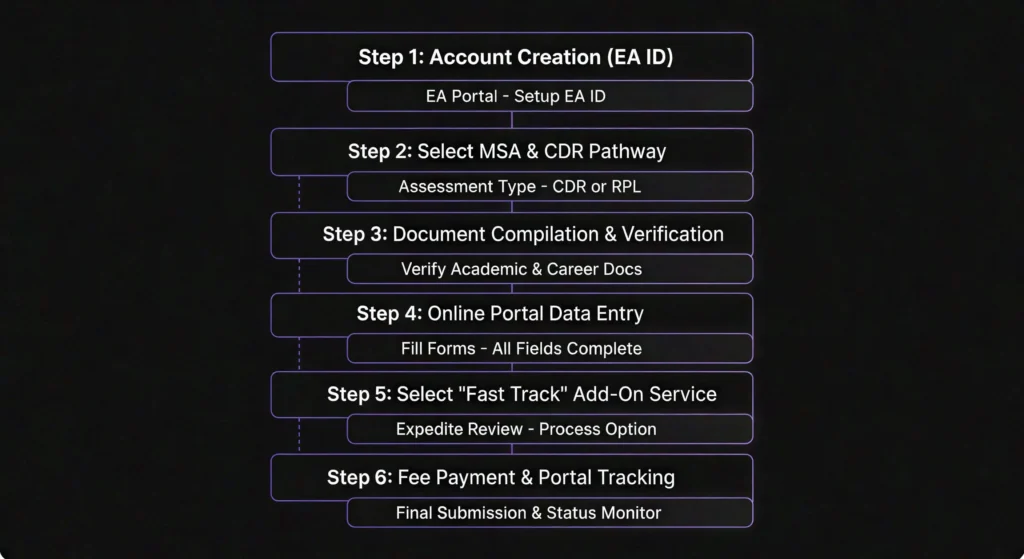
Step-by-Step Application Process
- Create or Access Your Engineers Australia Account: Visit the official Engineers Australia portal and register for an EA ID (or log in if you already have one).
- Select Migration Skills Assessment (MSA): Choose the MSA option from the portal services menu.
- Confirm Your Pathway: Select the Competency Demonstration Report (CDR) pathway if your engineering qualification is not accredited under an International Engineering Alliance Accord.
- Prepare and Format Your Documents: Organize color scans of original documents (identity documents, degree certificates, transcripts, CV, Continuing Professional Development log, three Career Episodes, and Summary Statement).
- Fill In the Online Application: Input personal details, academic history, and nominated occupation (e.g., Civil Engineer – ANZSCO 233211).
- Upload Electronic Documents: Attach files according to EA file naming and resolution conventions.
- Select the Fast-Track Option: During the fee checkout phase, check the box for “Fast Track / Priority Processing”.
- Pay Applicable Fees: Submit payment for both the base assessment fee and the CDR fast track fee using a valid credit card.
- Monitor Application Status: Regularly check your online portal status for updates or notifications.
Documents Required for a Fast Track CDR Application
Applying for expedited processing does not reduce the documentation burden. Submitting a complete, verified document set on day one is essential to avoid delays.
Identity Documents
- Current valid passport (bio-page).
- Official national identity card or name-change documentation (if applicable).
- Passport-size photo meeting EA specifications.
Academic Evidence
- Official Degree Certificate/Diploma graduation certificate.
- Complete academic transcripts showing all subjects, grades, and completion status.
- Course syllabus or curriculum outline (if requested for non-standard degrees).
Language Proficiency
- Valid English test results (IELTS, TOEFL iBT, or PTE Academic) meeting minimum score thresholds, unless exempt based on citizenship criteria specified in the MSA booklet.
Professional CDR Reports
- Curriculum Vitae (CV) / Resume: Comprehensive overview of academic history and engineering roles.
- Continuing Professional Development (CPD) Statement: Formatted listing of post-graduation learning, courses, conferences, and self-study.
- Three Career Episodes: Written engineering narratives following the strict Introduction, Background, Personal Engineering Activity, and Summary structure.
- Summary Statement: Matrix cross-referencing your Career Episodes against Engineers Australia’s competency elements for your nominated occupational category.
Employment Evidence (For Relevant Skilled Employment Assessment)
- Official work reference letters on company letterhead signed by supervisors.
- Objective third-party tax documents, pension records, bank statements showing salary credits, or official social security records.
Does Fast Track Guarantee a Positive CDR Assessment?
No. Fast-track processing expedites administrative handling; it does NOT guarantee a positive outcome.
Engineers Australia evaluates every application strictly on technical competence, documentation authenticity, and compliance with national professional engineering benchmarks.
An assessor will issue an unfavorable outcome or refuse an application if:
- The Career Episodes fail to demonstrate personal engineering competencies at the required level.
- The application relies heavily on team achievements without specifying individual tasks (“we designed” vs. “I calculated”).
- Plagiarism, copy-pasting, or unauthorized AI generation is detected.
- Documents cannot be independently verified.
Can a Fast Track CDR Application Still Be Delayed?
Yes. Selecting fast track guarantees queue placement within 20 business days, but overall completion can take longer due to several factors:
- Incomplete Uploads: Omitting required pages, submitting low-resolution scans, or missing degree certificates.
- Inconsistent Employment Evidence: Discrepancies between CV dates, reference letters, and tax/payroll documents.
- Issuance of an RFI: When an assessor requests additional proof, the 20-day assignment window is considered fulfilled, and the total timeline depends on how fast you respond.
- Third-Party Verification Checks: If Engineers Australia contacts your university or employers to verify credentials and receives delayed responses.
- Unclear Technical Explanations: Career Episodes that read like high-level project overviews rather than detailed technical reports on engineering problems solved.
How to Avoid Delays in Your CDR Fast Track Assessment
To maximize the efficiency of your fast track migration skills assessment, implement these operational tips before submitting:
- Verify Your ANZSCO Occupation: Select the correct occupational category (Professional Engineer, Technologist, Associate, Manager) matching your background.
- Perform a Quality Audit: Ensure all scanned documents are full-color, high-resolution original scans (no blurred phone photos).
- Cross-Check Personal Information: Ensure your name spelling, date of birth, and degree titles match across all passport, academic, and work records.
- Emphasize Personal Contributions: Structure Career Episodes using “I” statements (“I designed,” “I calculated,” “I modeled”) rather than passive team phrasing.
- Map the Summary Statement Accurately: Verify every paragraph indicator in your Summary Statement points directly to relevant paragraphs in your Career Episodes.
- Maintain Complete Employment Evidence: Provide third-party financial records (tax declarations, social security payment slips) alongside official reference letters.
- Eliminate Uncredited Content: Never copy text from sample CDRs online. Run your report through plagiarism checks before submission.
- Keep Contact Details Current: Regularly check the email account associated with your EA portal to respond immediately to any assessor inquiries.
- Organize CPD Chronologically: Present a structured table listing training dates, course titles, providers, duration, and locations.
- Keep File Upload Copy: Retain identical copies of all uploaded PDF files for reference if an RFI is raised.
CDR Fast Track Assessment vs Other Migration Skills Assessments
Engineers Australia evaluates engineering occupations specifically. Other assessing authorities manage different professional disciplines in Australia and operate under independent fee structures, processing timelines, and priority rules:
- Engineers Australia (EA): Assesses engineers; offers a standard fast-track option with a 20-business-day assignment timeframe.
- Australian Computer Society (ACS): Assesses ICT professionals; handles priority processing on a case-by-case basis for urgent visa deadlines.
- VETASSESS: Assesses general professional trades and occupations; offers an independent priority processing queue subject to daily slot limits.
- Trades Recognition Australia (TRA): Assesses trade occupations; operates under separate processing streams without a direct CDR equivalent.
Applicants must confirm their correct ANZSCO code and designated assessing authority before applying.
Frequently Asked Questions About CDR Fast Track Assessment
Is the CDR fast track fee separate from the normal assessment fee?
Yes. The fast-track fee is an additional service charge added on top of the standard CDR assessment fee.
Does Engineers Australia guarantee a fast-track CDR result within 20 business days?
No. Engineers Australia guarantees that an assessor will be assigned to review your application within 20 business days. The final outcome timeline depends on application quality and whether an RFI is issued.
Who is eligible for Engineers Australia fast track assessment?
Any engineering applicant applying for a Migration Skills Assessment via the CDR pathway, Washington Accord, Sydney Accord, Dublin Accord, or Australian qualification pathway can request fast-track processing.
Can I apply for fast track after submitting my CDR application?
Yes. Applicants can upgrade a pending standard application to fast track through their Engineers Australia portal by paying the additional priority processing fee.
Does fast track guarantee a positive CDR assessment?
No. Fast track accelerates administrative processing queue placement. Your portfolio is evaluated against standard technical and competency requirements.
What can delay a fast track CDR application?
Delays are primarily caused by missing documents, incomplete employment references, ambiguous Career Episodes, low-quality document scans, plagiarism flags, or slow responses to RFIs.
What documents are required for a fast track CDR application?
You need a passport, academic degree certificates, transcripts, English language test results (if required), CV/resume, CPD log, three Career Episodes, a Summary Statement, and third-party employment evidence.
How can I reduce my CDR assessment processing time?
Ensure your application is decision-ready before submission: verify all transcripts, eliminate technical errors, cross-check Summary Statement references, provide primary work evidence, and respond immediately to portal notifications.