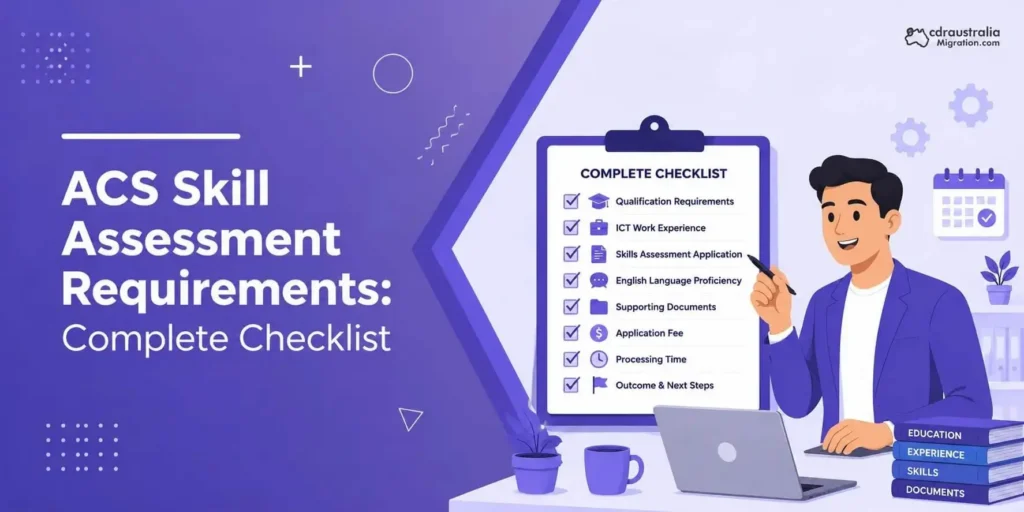
Navigating the pathway to skilled migration in Australia as an Information and Communications Technology (ICT) professional requires a clear understanding of the ACS Skill Assessment Requirements. The Australian Computer Society (ACS) is the designated assessing authority for ICT occupations under Australia’s Migration Skills Assessment program.
Whether you are applying for a Skilled Independent visa (subclass 189), Skilled Nominated visa (subclass 190), or Skilled Work Regional (Provisional) visa (subclass 491), obtaining a suitable assessment outcome from ACS is a crucial initial step. This comprehensive guide outlines the eligibility criteria, qualification and work experience rules, document checklist, application pathways, and common pitfalls to avoid when preparing your application.
What Is an ACS Skills Assessment?
An ACS skills assessment evaluates whether an applicant’s tertiary educational qualifications and professional work experience align with Australian standards for a nominated ICT occupation.
ACS evaluates two core components:
- Qualifications: Determining if your degree, diploma, or vendor certification contains sufficient ICT content and aligns with Australian Higher Education standards.
- Employment Experience: Verifying whether your work history is closely related to your nominated ANZSCO code and calculated at an appropriate professional level.
Key Takeaway: The final outcome letter issued by ACS indicates whether your skills and qualifications have been assessed as suitable for your nominated ICT occupation and establishes your Skill Requirement Met Date for Department of Home Affairs point-test calculations.
Who Needs an ACS Skills Assessment?
You require an ACS assessment for Australia if you are applying for skilled migration under an ICT or computing-related occupation listed on the Australian Skilled Occupation List. Common nominated occupations include:
- Software Engineer (ANZSCO 261313)
- ICT Business Analyst (ANZSCO 261111)
- Systems Analyst (ANZSCO 261112)
- Developer Programmer (ANZSCO 261312)
- Database Administrator (ANZSCO 262111)
- Computer Network and Systems Engineer (ANZSCO 263111)
- Cyber Security Specialist (ANZSCO 262112)
- Web Developer (ANZSCO 261212)
Core ACS Skill Assessment Requirements
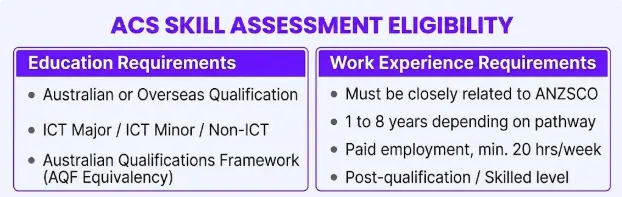
To meet ACS skills assessment requirements, applicants must satisfy specific criteria across education, work experience, and documentation.
1. Educational Qualifications
ACS evaluates qualifications based on standard equivalencies established by the Australian Qualifications Framework (AQF):
- AQF Bachelor Degree or Higher: Bachelor, Master, or Doctoral degrees.
- AQF Associate Degree / Advanced Diploma / Diploma: Higher education or vocational qualification with a strong ICT component.
- Vendor Certifications: Certain high-level industry certifications (e.g., specific Microsoft or Cisco certifications) are recognized as equivalent to AQF diploma levels.
Qualification Relevance and ICT Content
Qualifications are classified into three categories:
- ICT Major: Contains a significant percentage of ICT units relevant to the nominated occupation (typically 33% or higher for a 3-year degree).
- ICT Minor: Contains moderate ICT content (typically 18%–32% for a 3-year degree).
- Non-ICT: Contains minimal or no relevant ICT content.
2. Professional Work Experience
Work experience must meet the following baseline conditions to be counted towards your assessment:
- Professional Level: Tasks performed must match the depth and complexity defined in the official ANZSCO description for your nominated occupation.
- Working Hours: Employment must be paid and involve a minimum of 20 hours per week.
- Skill Requirement Met Date: ACS deducts a specific number of years of work experience to establish the threshold where you became “fully skilled.” Only work experience completed after this date is eligible for points under the Department of Home Affairs skilled migration points test.
3. English Language Requirements
While ACS does not strictly enforce English proficiency tests (such as IELTS or PTE) directly for the skill assessment itself, demonstrating functional English may be required depending on your specific pathway, and English proficiency test scores are mandatory when submitting your Expression of Interest (EOI) to the Department of Home Affairs.
ACS Skills Assessment Pathways Overview
Selecting the correct ACS assessment pathway is vital. Your choice depends on where you completed your education and the proportion of ICT content in your degree.
| Assessment Pathway | Target Applicant Group | Minimum ICT Qualification Required | Required Work Experience |
|---|---|---|---|
| Temporary Graduate (Subclass 485) | Recent Australian Graduates | Australian AQF Bachelor degree or higher (ICT Major) | No work experience required |
| Post Australian Study | Australian Graduates with work/Professional Year | Australian AQF Bachelor degree or higher (ICT Major) | 1 year relevant work experience OR completion of ACS Professional Year |
| General Skills Application | Applicants with ICT Degrees (Australian or Overseas) | Overseas or Australian AQF Diploma to Master (ICT Major/Minor) | 2 to 4 years relevant experience depending on major/minor match |
| Recognition of Prior Learning (RPL) | Non-ICT Degree holders or No Tertiary Qualification | Non-ICT Degree OR No Formal Tertiary Qualification | 6 years (with Non-ICT degree) or 8 years (with no formal degree) + RPL Project Report |
ACS RPL Assessment Requirements
The ACS RPL assessment (Recognition of Prior Learning) is designed for IT professionals who do not hold formal ICT qualifications but have accumulated significant industry experience.
Key Criteria for RPL Applicants:
- RPL Application Form: You must complete an official ACS RPL Project Report detailing your practical knowledge across specific Core Body of Knowledge topics.
- Project Reports: You must submit two project reports demonstrating how you applied ICT knowledge in real-world professional environments:
- One project completed within the last 3 years.
- One project completed within the last 5 years.
- Work Experience Threshold:
- Non-ICT Qualification: Requires at least 6 years of relevant full-time work experience.
- No Formal Qualification: Requires at least 8 years of relevant full-time work experience.
ACS Skills Assessment Document Checklist
Preparing clear, accurate, and properly formatted documentation is essential to avoid processing delays. All documents must be high-resolution color scans of original documents.
Identity Documents
- [✓] Passport ID page (showing name, photo, and date of birth).
- [✓] Secondary identification document (e.g., national ID card or driver’s license).
- [✓] Name change evidence (if applicable).
Academic Evidence
- [✓] Official Graduation Certificate / Degree Award.
- [✓] Official Academic Transcripts detailing course units, subjects, and marks/grades achieved.
- [✓] Course syllabus/curriculum description (recommended for non-standard overseas qualifications or RPL applications).
Employment Evidence
- [✓] Official Employer Reference Letters (on official company letterhead, signed by an authorized supervisor or HR manager).
- [✓] Third-Party Financial Evidence (at least two independent financial proofs per employment period):
- Official Tax Statements / Tax Returns
- Pay slips (first and last pay slips per year of employment)
- Bank Statements showing salary deposits
- Official Superannuation / Social Security contribution records
- [✓] Detailed Curriculum Vitae / Resume.
RPL Specific Evidence (If Applicable)
- [✓] Completed ACS RPL Project Report document.
- [✓] Detailed project artifacts or employer confirmations verifying your direct involvement in nominated projects.
Detailed Employment Reference Letter Requirements
An incomplete employment reference letter is one of the primary reasons for assessment delays or negative outcomes. Each reference letter must include the following details:
- Official Letterhead: Company logo, registered name, contact details, and physical address.
- Dates of Employment: Exact start date and end date (or “To Present” if currently employed) formatted as DD/MM/YYYY.
- Position Title: Official job title corresponding to your role.
- Hours Worked: Explicit declaration of hours worked per week (must be at least 20 hours/week).
- Work Location: Country and city where employment was performed.
- Detailed Job Duties: A clear list of 5–8 specific duties performed daily, matching the depth of the relevant ANZSCO code.
- Signatory Details: Full name, position title, official work email address, and direct telephone number of the referee.
Step-by-Step Guide: How to Apply for an ACS Skills Assessment
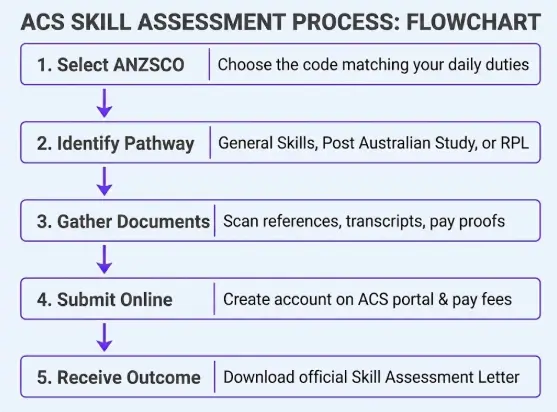
- Choose Your Nominated ANZSCO Occupation: Match your core duties and academic background to the official ANZSCO occupation guidelines.
- Select the Right Assessment Pathway: Identify whether you qualify under Post Australian Study, General Skills, or Recognition of Prior Learning (RPL).
- Gather & Prepare Documentation: Request reference letters from employers and gather supporting financial records (tax returns, pay slips, bank statements).
- Create an Account on the ACS Portal: Complete the online application form and upload high-resolution color PDF scans.
- Pay the Assessment Fee: Pay the required fee using a credit card.
- Track Status & Receive Outcome: Assessment processing generally takes several weeks. Once complete, you will receive an official electronic outcome letter via email.
Common Reasons for ACS Assessment Delays or Unfavorable Outcomes
To ensure a smooth process, avoid these common mistakes:
Warning – Common Pitfalls
- Generic Job Descriptions: Copying and pasting ANZSCO duty descriptions verbatim into reference letters can result in rejection for lack of authenticity.
- Insufficient Financial Evidence: Providing reference letters without independent third-party evidence (such as tax records or bank statements) leads to unverified employment periods.
- Incorrect ANZSCO Code Selection: Applying for an ANZSCO code that does not match your academic background or reference letters can result in an “unsuitable” result.
- Inadequate RPL Reports: Submitting plagiarized or superficial project reports in the RPL pathway.
- Missing Details on Reference Letters: Omission of working hours, start/end dates, or authorized signatures.
ACS Skills Assessment and Australian PR
Obtaining a positive ACS migration skills assessment is a critical requirement for skilled migration, but it is important to understand how it fits into the broader visa process:
- Points Test Contribution: The ACS outcome letter provides your Skill Requirement Met Date. Only work experience completed after this date can be claimed for points under the Department of Home Affairs point test.
- EOI Submission: A valid positive assessment is required to submit an Expression of Interest (EOI) through SkillSelect.
- Assessment Validity: ACS assessment letters are valid for 2 years from the date of issue.
- Important Distinction: A positive ACS assessment verifies your qualifications and work experience for migration purposes. It does not guarantee a visa invitation, visa approval, or permanent residency from the Department of Home Affairs.
Summary Checklist: ACS Skill Assessment Requirements
- [] Selected an ANZSCO occupation closely aligned with your qualification and duties.
- [] Identified your qualification level (AQF equivalent) and ICT content ratio (Major/Minor/Non-ICT).
- [] Determined your correct assessment pathway (General Skills, Post-Australian, or RPL).
- [] Prepared high-resolution, color scans of original identity documents and academic records.
- [] Secured detailed employment reference letters on official company letterheads.
- [] Collected at least two forms of financial proof per employment role (tax returns, pay slips, bank records).
- [] Completed the RPL project report (if applying via non-ICT or no-degree pathways).
- [] Double-checked all documents for consistency in dates, job titles, and personal details.
Frequently Asked Questions
What are the ACS skill assessment requirements?
ACS skill assessment requirements include holding a recognized tertiary qualification (or equivalent vendor certification) and relevant ICT work experience. Applicants must provide high-resolution color scans of identity documents, academic transcripts, degree awards, formal employment reference letters, and supporting financial evidence (tax returns or pay slips).
What documents are required for an ACS assessment?
The standard documents required include your passport ID page, degree certificates, academic transcripts, detailed employment reference letters detailing job responsibilities, and third-party financial records (pay slips, tax documents, or bank statements showing salary deposits).
How much work experience is required for ACS?
Required work experience varies by pathway:
- ICT Major degree (closely related): 2 years of relevant experience within the past 10 years, or 4 years completed at any time.
- ICT Major degree (not closely related): 4 years of relevant experience.
- ICT Minor degree: 5 or 6 years of relevant experience depending on relevance.
- Non-ICT Degree (RPL): 6 years of relevant experience.
- No Formal Degree (RPL): 8 years of relevant experience.
Can I apply for an ACS assessment without an ICT degree?
Yes. If you have a non-ICT degree or no formal tertiary qualification, you can apply under the Recognition of Prior Learning (RPL) pathway. You will need to demonstrate substantial industry experience (6 to 8 years) and complete an ACS RPL Project Report.
What is an ACS RPL assessment?
An ACS RPL (Recognition of Prior Learning) assessment allows IT professionals without formal ICT qualifications to demonstrate that their industry experience has provided them with equivalent professional knowledge. Applicants must submit two detailed project reports alongside extensive employment evidence.
How long does an ACS skills assessment take?
Processing times generally range from 4 to 8 weeks, depending on the complexity of the application, pathway type (RPL applications may take longer), and document clarity. Incomplete documentation or requests for additional evidence can extend processing times.
Is an ACS skills assessment required for Australian skilled migration?
Yes. If you are applying as a primary applicant under an ICT occupation for points-based skilled migration visas (such as Subclass 189, 190, or 491), a positive skills assessment from ACS is mandatory.
How long is an ACS skills assessment valid?
An ACS skills assessment outcome letter is valid for 2 years from its date of issue.
Conclusion
Successfully completing an ACS skills assessment requires careful preparation, accurate document gathering, and a clear understanding of how your qualifications and employment history align with Australian standards. By selecting the correct pathway, ensuring your reference letters meet all formatting guidelines, and providing complete financial proof, you can significantly improve your chances of a positive assessment outcome.
Before submitting your application, review all official guidelines directly on the ACS portal or consult a registered migration agent (MARA) to ensure your application reflects the most current requirements.