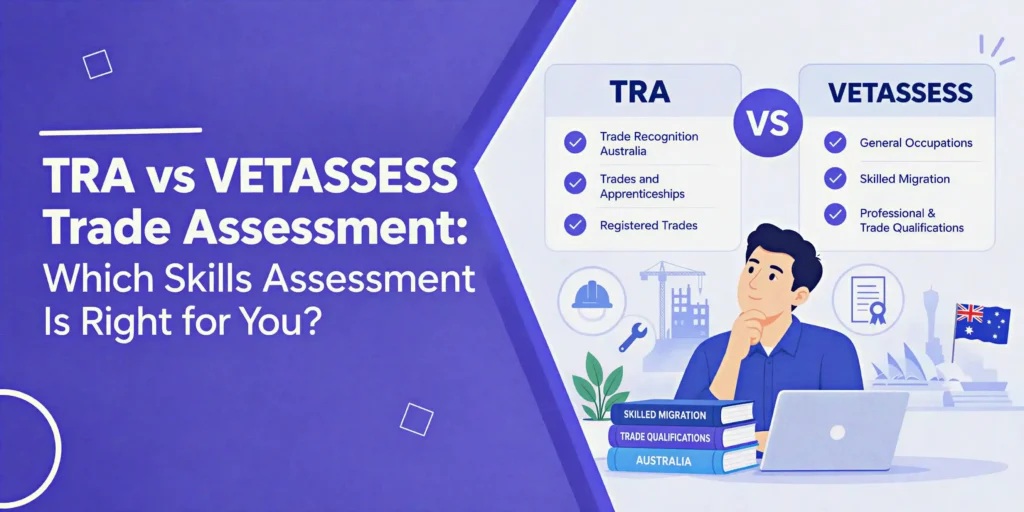
If you are an international applicant or an Australian vocational graduate pursuing permanent residency, you will almost certainly encounter Trades Recognition Australia (TRA) and VETASSESS. Demystifying the rules surrounding a TRA vs VETASSESS trade assessment is vital before gathering a single document.
This detailed guide breaks down how a trade skills assessment Australia pathway operates, contrasts the specific criteria set by TRA and VETASSESS, and provides a clear decision model to help you lodge a successful application.
What Is Australia Trade Skills Assessment?
A trade skills assessment is a formal evaluation used by the Australian Government to verify that an overseas or locally trained tradesperson possesses technical knowledge, formal qualifications, and practical experience equivalent to domestic benchmarks.
Whether you are applying for independent skilled migration (subclass 189), state-nominated streams (subclass 190), regional work visas (subclass 491), or employer-sponsored visas (subclass 482), Home Affairs demands proof of trade competency through an authorized assessing body.
An Australian trade assessment assesses four foundational pillars:
- Educational Comparability: Evaluating foreign apprenticeships, diplomas, or trade certificates against the Australian Qualifications Framework (AQF)—typically at the Certificate III, Certificate IV, or Diploma tier.
- Workplace History: Verifying the continuity, recency, and depth of your paid post-qualification employment.
- ANZSCO Alignment: Verifying that your everyday tasks match the official Australian and New Zealand Standard Classification of Occupations definition for your nominated role.
- Practical Competency: Testing hands-on skills through interactive interviews or practical workshop evaluations for high-risk and licensed vocations.
A positive outcome letter assures Australian regulatory bodies and employers that you can safely integrate into the national workforce without compromising quality or safety.
What Is a TRA Skills Assessment?
Trades Recognition Australia (TRA) is a specialized unit housed within the Department of Employment and Workplace Relations. As an official government authority, TRA oversees trade evaluations across metalworking, automotive services, electrical engineering, construction, and hospitality sectors.
A TRA skills assessment is administered across several distinct programs tailored to specific applicant backgrounds:
- Migration Skills Assessment (MSA) Stream: Targeted at offshore applicants holding formal trade credentials who require a skills outcome for skilled migration visas.
- Job Ready Program (JRP): A structured, four-stage employment program designed for international student graduates holding Australian vocational qualifications.
- Offshore Skills Assessment Program (OSAP): A program for candidates in specific occupations and passport countries that involves documentary checks alongside practical or technical testing.
- Provisional Skills Assessment (PSA): The foundational step of the JRP, primarily utilized by international graduates lodging Temporary Graduate (subclass 485) visas.
- TSS Skills Assessment: Designed specifically for applicants applying for temporary employer-sponsored visas (such as the subclass 482 stream).
Important Reminder: Because specific TRA assessment requirements vary drastically between programs, reviewing the official TRA Pathfinder guidance is essential before submitting your file.
What Is a VETASSESS Skills Assessment?
VETASSESS, which stands for Vocational Education and Training Assessment Services, is the largest organization in Australia responsible for assessing skills. In addition to evaluating numerous professional and executive managerial positions, VETASSESS is also a TRA-approved Registered Training Organization (RTO) that conducts trade skills assessments for 27 specific trade occupations.
Trades evaluated under a VETASSESS skills assessment include Electricians, Plumbers, Cooks, Chefs, Motor Mechanics, Carpenters, Welders, and Bricklayers.
A VETASSESS trade assessment divides applicants into two operational pathways:
Pathway 1
For individuals who do not possess a formal Australian qualification or an Australian trade license. This pathway involves a thorough documentary audit followed by mandatory technical assessments (such as a remote technical interview and/or a hands-on practical exam).
Pathway 2
For individuals holding an Australian Vocational Education and Training (VET) qualification or an Australian occupational license. This route focuses on validating credentials and verifying ongoing employment through documentation and a technical interview.
Securing a “Suitable” letter from VETASSESS grants you the official credential required for your Australian visa application.
TRA vs VETASSESS Trade Assessment: Which One Do You Need?
Finding out which evaluating body applies to your migration strategy is a deterministic process. You cannot pick an authority based on pricing, speed, or subjective preference.
To establish your exact pathway, review these critical factors:
- Nominated Occupation Code: Every skilled trade is assigned a specific six-digit ANZSCO code linked to a designated authority on the Department of Home Affairs Skilled Occupation List.
- Passport Origin: Under the Offshore Skills Assessment Program (OSAP), holding a passport from a specified country may require you to submit your trade application through a TRA-approved RTO such as VETASSESS. If your country is omitted from that list, you may fall under TRA’s direct Migration Skills Assessment (MSA) pathway.
- Training Location: Earning your trade qualification in Australia versus overseas changes whether you follow TRA’s Job Ready Program or VETASSESS Pathway 2.
- Licensing Classifications: High-risk trades like Electrician (General) or Plumber (General) mandate practical workshop assessments regardless of your background.
Concise Decision Guide
- Condition A: Your ANZSCO code specifies TRA and your passport/training leads to direct government assessment → Apply through the appropriate TRA stream (e.g., MSA or JRP).
- Condition B: Your trade is one of the 27 roles delegated to VETASSESS for your country of citizenship → Apply via VETASSESS Trade Skills Assessment (Pathway 1 or Pathway 2).
- Condition C: Unsure about overlapping rules → Verify requirements using official TRA and Home Affairs portals before paying fees.
TRA Assessment Requirements
Meeting standard TRA assessment requirements requires presenting a fully documented, verifiable portfolio covering personal credentials, vocational education, and work history.
Key evidence files needed for a TRA application include:
1. Personal & Identity Records
- Passport bio-data page with clear photo clarity.
- Secondary identification documents (driver’s license or national identity card).
- Official legal documentation if your name has changed.
2. Qualifications & Course Structure
- Official trade diplomas, completion certificates, or apprenticeship credentials.
- Full academic transcripts highlighting completed course modules, classroom hours, and practical training units.
- Verification details for the issuing educational institution.
3. Employment Evidence & Financial Proof
- Employer Reference Letters: These are the formally issued references on the official company letterhead signed by the authorized supervisors and are clearly stating employment dates, weekly working hours and detailed breakdowns of daily trade tasks.
- Financial Substantiation: Year-by-year financial verification matching all claimed work periods (such as official tax returns, government pension/social security statements, payslips, or stamped bank statements showing direct wage deposits).
- Self-Employed Trade Applicants: Business registration files, official tax filings, invoice histories, material purchase orders, and certified statements from an accredited accountant.
VETASSESS Trade Assessment Requirements
For a VETASSESS trade assessment, document submissions must satisfy specific criteria depending on your assigned pathway.
Required Documentation Checklist
- Identity Files: High-resolution color scans of your passport bio-page, passport-style photographs, and government-issued national ID cards.
- Educational Evidence: Trade credentials, technical diplomas, or an AQF Certificate III/IV (mandatory for Pathway 2).
- Workplace Experience: Evidence establishing at least 12 months of full-time (or equivalent part-time) employment in your trade within the preceding 3 to 5 years.
- Video/Photo Evidence: Contextual photographs or short video recordings showing you carrying out trade tasks in proper personal protective equipment (PPE) inside an operational workplace (frequently required for Stage 2 preparations).
- Third-Party Payment Trail: Government tax summaries, official wage statements, and pension records proving genuine paid employment.
Technical Interview and Practical Assessment Stage
For Pathway 1 applicants who successfully pass the Stage 1 document review, Stage 2 involves a technical assessment. This takes the form of an interactive technical interview held in English with a certified Australian trade examiner. For licensed fields like plumbing or electrical work, candidates must also complete a hands-on practical evaluation at an approved testing venue.
TRA vs VETASSESS Assessment Process
While both bodies evaluate trade competence, their submission steps follow distinct paths:
TRA Assessment Sequence
(Migration Skills Assessment Example)
- Confirm ANZSCO Code: Ensure your trade is mapped to TRA on the skilled occupation list.
- Confirm Program Eligibility: Use the TRA Pathfinder tool to verify that MSA is your correct application path.
- Compile Portfolio: Gather verified educational records, reference letters, and financial proof.
- Register Online Account: Create a portal profile on the official TRA site.
- Lodge & Pay: Upload documents, submit the digital form, and settle the processing fee.
- Background Audits: TRA assessors perform independent checks with employers and training providers.
- Receive Outcome: Download your official TRA outcome letter upon successful completion.
VETASSESS Trade Assessment Sequence
(Offshore Pathway Example)
- Verify Evaluating Body: Confirm your trade is assessed by VETASSESS.
- Determine Pathway: Identify whether you qualify under Pathway 1 or Pathway 2.
- Stage 1 Submission: Create an online account, upload identity, training, and work records, and pay the Stage 1 fee.
- Stage 1 Document Review: VETASSESS assesses the validity and completeness of your submitted portfolio.
- Stage 2 Booking: Upon receiving Stage 1 approval, settle the Stage 2 fee and reserve your interview or workshop slot.
- Technical Evaluation: Complete your technical interview or practical assessment with an Australian trade assessor.
- Receive Assessment Result: Download your co-branded outcome letter.
TRA vs VETASSESS Fees and Processing Time
Budgeting accurately requires knowing the current costs and processing timelines associated with your assigned pathway.
Trades Recognition Australia (TRA) Sample Fee Structure
- Migration Skills Assessment (MSA): ~$1,000 AUD (documentary review).
- Offshore Skills Assessment Program (OSAP): Managed in stages through assigned RTOs (accumulating up to ~$5,320 AUD total for Pathway 1 including document checks, technical interviews, and workshop testing).
- Job Ready Program (JRP): Paid in separate installments across four steps.
VETASSESS Trade Assessment Sample Fee Structure
- Pathway 1 Stage 1 (Documentary Review): ~$1,120 AUD.
- Pathway 1 Stage 2 (Technical Interview): ~$2,000 AUD.
- Pathway 1 Stage 2 (Practical Workshop Test – Licensed Roles): ~$2,200 AUD.
- Pathway 2 (Combined Document Review + Technical Interview): ~$2,020 AUD total.
Standard Processing Windows
- TRA MSA Assessment: Generally processed within 90 to 120 days from lodging.
- VETASSESS Stage 1 Audit: Typically completed in 8 to 12 weeks.
- VETASSESS Stage 2 Interview & Results: These vary between 4 to 8 weeks and are based on the assessor availability and testing center schedules.
Crucial Notice: Processing fees and assessment turnarounds are updated periodically. Always confirm pricing directly on official TRA or VETASSESS websites before submitting your application.
Common Mistakes When Choosing Between TRA and VETASSESS
Steer clear of these frequent errors to avoid delays and re-application expenses:
- Self-Selecting Your Authority: Assuming you can pick your preferred assessing body instead of following official government allocations.
- Choosing the Incorrect ANZSCO Code: Choosing an occupation code that does not match your daily workplace responsibilities.
- Following the Outdated Information: Relying the outdated forum threads and website information rather than current official guidelines.
- Submitting Generic Reference Letters: Using generic reference letters copied directly from ANZSCO descriptions instead of detailing your actual duties.
- Inadequate Financial Evidence: Failing to submit third-party payment proof (such as tax slips, bank statements, or pension records) alongside reference letters.
- Ignoring Country-Specific Guidelines: Missing specific passport or country rules under TRA OSAP frameworks.
- Not Taking Technical Interviews seriously: Going to a technical interview without reviewing Australian work safety rules, tool terminology and industry standards.
- Submitting Certified Translations Incorrectly: Providing non-English documents without certified translations from an accredited translator.
- Confusing Skills Assessment with Trade Licensing: Assuming a positive skills assessment automatically grants you a license to practice a regulated trade in Australia without state board approval.
- Inconsistent Employment History: Presenting conflicting dates across resumes, employer letters, tax forms, and visa portal submissions.
How to Choose the Right Trade Skills Assessment in Australia
Follow this step-by-step roadmap to identify and apply through the correct pathway:
- Define Your Occupation: Select the trade role that matches your work history.
- Finding your ANZSCO Code: Locate your six-digit occupational code on the Home Affairs skilled list.
- Identify the Assigned Authority: Confirm whether the list assigns your trade to TRA or VETASSESS.
- Determine the Correct Stream: Use the TRA Pathfinder or VETASSESS trade tools to establish your specific stream.
- Review Current Guidelines: Download official guideline handbooks from your assigned assessing body.
- Audit Your Documents: Ensure all certificates, transcripts, reference letters, and tax records meet formatting and verification rules.
- Prepare for Technical Examinations: Brush up on Australian industry vocabulary, safety rules, and operational protocols if an interview or workshop test applies.
- Verify Current Pricing: Confirm costs on the official portal before making payment.
- Submit a Complete Application: Upload all requested files in a single, well-organized submission.
Does securing a Positive Skills Assessment Guarantee an Australian Visa?
Not quiet. Even after securing a positive skills assessment outcome, it does not guarantee visa approval.
A “Suitable” skills assessment confirms only that your training and work experience meet the required standards for your trade. It fulfills one specific migration requirement, but it does not replace overall visa criteria.
To secure a skilled visa, you must also satisfy additional Department of Home Affairs requirements, including:
- Age criteria (typically under 45 for points-tested streams).
- English language proficiency requirements (IELTS, PTE Academic, OET, or TOEFL).
- EOI points thresholds for points-tested streams (subclass 189, 190, 491).
- State or regional nomination requirements.
- Health, character, and police background checks.
- Relevant employment criteria specified by Home Affairs.
Always assess your complete visa profile alongside your skills assessment application.
Frequently Asked Questions About TRA vs VETASSESS
What is the difference between TRA and VETASSESS?
Trades Recognition Australia (TRA) is a primary Australian Government assessing authority overseeing trade occupations. VETASSESS evaluates professional occupations while also functioning as a TRA-approved Registered Training Organization (RTO) to conduct trade assessments for designated occupations and passport streams.
Is TRA the same as VETASSESS?
No. TRA is a government unit within the Department of Employment and Workplace Relations. VETASSESS is an authorized assessing body that conducts trade skills assessments on behalf of TRA for specific occupations and pathways.
Which is better, TRA or VETASSESS?
Neither body is inherently “better” or easier. Both enforce strict Australian qualification and industry standards. Your assigned authority depends on your nominated occupation, passport country, and visa stream.
How do I know whether I need a TRA skills assessment?
You require a TRA assessment if your nominated occupation designates TRA as the evaluating body on the Home Affairs skilled list and you meet the criteria for direct TRA programs like Migration Skills Assessment (MSA) or Job Ready Program (JRP).
What is a VETASSESS trade assessment?
A VETASSESS trade assessment is an evaluation process for tradespeople that includes a Stage 1 documentary review followed by a Stage 2 technical assessment (technical interview and/or practical workshop examination).
Can I choose between TRA and VETASSESS?
No, applicants cannot choose an evaluating body based on personal preference. The applicable authority is fixed based on ANZSCO occupation codes, passport origin, and migration program rules.
Does TRA assess all trade occupations?
TRA oversees the majority of trade occupations, but delegates specific trades and offshore passport streams to approved RTOs like VETASSESS.
Does VETASSESS assess trade occupations?
Yes, VETASSESS evaluates 27 specific trade occupations in addition to its catalog of over 340 professional occupations.
Do TRA and VETASSESS require practical assessments?
Yes, practical assessments are required for certain high-risk or licensed trades (such as Plumbers and Electricians) under specific programs like the Offshore Skills Assessment Program (OSAP).
Does a positive TRA or VETASSESS assessment guarantee a visa?
No. A positive assessment satisfies the skills requirement for your nominated occupation, but you must still meet all Home Affairs visa criteria, including age, English language, health, and character checks.
Final Verdict: TRA vs VETASSESS Trade Assessment
Before gathering documents or paying assessment fees, verify your ANZSCO occupation code on the Australian Government Skilled Occupation List, check the official TRA Pathfinder tool, and confirm whether your passport country requires an RTO assessment via VETASSESS. Complete, verifiable documentation remains the single most important factor for securing a positive outcome.