
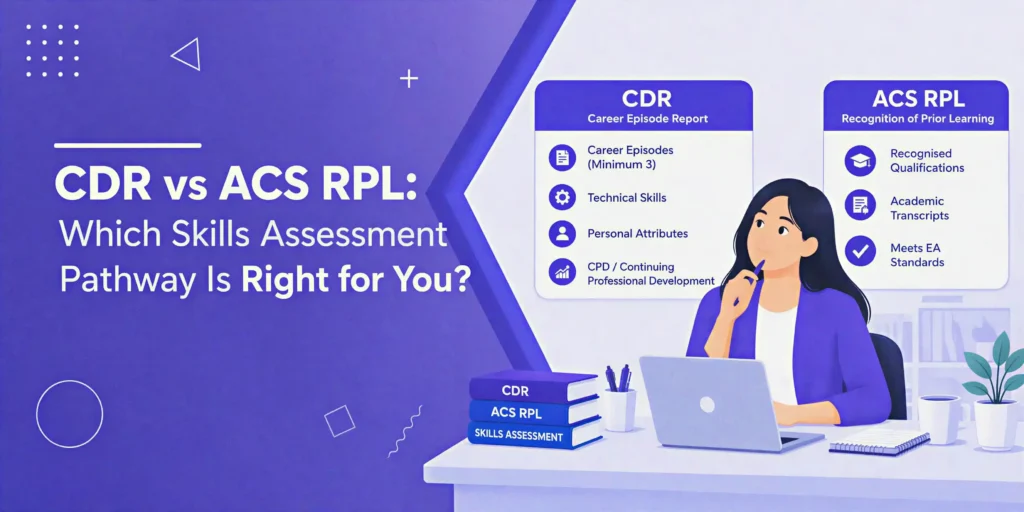
Choosing the right assessment pathway is not a matter of personal convenience or speed. Instead, CDR vs ACS RPL Australia represents two distinct administrative systems designed for entirely different professions. An engineering applicant cannot simply opt for an ICT assessment, nor can an IT professional submit a Competency Demonstration Report to Engineers Australia.
In this comprehensive guide, you will learn the fundamental differences between Engineers Australia CDR vs ACS RPL, who each pathway is intended for, their respective eligibility criteria, required documentation and the way for you to determine the correct route for your specific career background.
What Is CDR for Engineers Australia?
The Competency Demonstration Report (CDR) is the primary assessment pathway administered by Engineers Australia for engineering professionals whose qualifications are not covered by international agreements like the Washington, Sydney, or Dublin Accords.
Engineers Australia acts as the designated assessing authority for engineering occupations in Australia. The purpose of a CDR is to allow applicants to demonstrate that their technical knowledge and acquired skills meet the competency standard of an Australian professional engineer, engineering technologist, engineering associate, or engineering manager.
Your nominated engineering occupation dictates the specific competencies you must prove. A CDR evaluation assesses your academic background alongside your demonstrated professional experience through three core components:
- Continuing Professional Development (CPD): A record showing how you keep your engineering knowledge up to date.
- Three Career Episodes: Detailed narratives describing specific periods or projects where you applied your engineering expertise.
- Summary Statement: A matrix linking your career episode competencies to the specific competency standards set by Engineers Australia.
Applicants must consult the current Engineers Australia guidelines before preparation begins. It is also important to remember that not every engineering applicant requires a full CDR; those with fully accredited qualifications often use streamlined assessment pathways.
What Is ACS RPL for ICT Professionals?
The Recognition of Prior Learning (RPL) is a specialized assessment pathway administered by the Australian Computer Society (ACS) for ICT professionals who do not hold an ICT qualification comparable to an Australian Qualifications Framework (AQF) degree, or whose degree has insufficient ICT content.
The ACS Migration Skills Assessment evaluates whether an applicant’s skills and professional experience align with a nominated ICT occupation and its corresponding ANZSCO code. The RPL pathway allows experienced practitioners to substitute formal tertiary education with documented professional competence.
Unlike general ICT pathways, the ACS RPL framework requires candidates to submit two RPL project reports. These reports must demonstrate how the applicant acquired their ICT knowledge through real-world work experience. In addition to project reports, candidates must provide evidence of professional currency, detailed employment reference letters, and statutory declarations or payment evidence to verify their career history.
CDR vs ACS RPL: Key Differences Explained
While both assessments serve as gateways to Australian skilled migration, they operate under entirely different administrative frameworks. The table below shows the main differences between these two pathways:
| Comparison Factor | CDR Pathway | ACS RPL Pathway |
|---|---|---|
| Assessing Authority | Engineers Australia | Australian Computer Society (ACS) |
| Primary Professional Area | Engineering | ICT, subject to eligible occupations |
| Main Purpose | Demonstrate engineering competencies | Demonstrate ICT knowledge through prior learning and professional experience |
| Intended Applicants | Eligible engineering applicants requiring the CDR pathway | Eligible ICT applicants meeting the RPL criteria |
| Qualification Considerations | Depends on accreditation, qualification type, and nominated occupation | Depends on ACS pathway eligibility and the applicant’s educational background |
| Experience Considerations | Relevant engineering experience or project work supports the application | Relevant professional ICT employment is central to RPL eligibility |
| Main Written Evidence | Career episodes and summary statement, plus CPD | Two RPL project reports and professional currency evidence |
| Occupational Classification | Relevant engineering occupation and category | Relevant ICT occupation and ANZSCO code |
| Assessment Criteria | Engineers Australia competency standards | ACS assessment criteria |
| Application Documentation | Engineering qualifications, identity documents, and CDR components | Identity, employment, project reports, and professional currency evidence |
| Cost | Verify current official Engineers Australia fee schedules | Verify current official ACS fee schedules |
| Processing Time | Check current official processing information | Check current official processing information |
| Suitable For | Applicants who meet applicable CDR pathway criteria | Applicants who meet applicable ACS RPL pathway criteria |
Understanding the Core Distinctions
Examining the ACS RPL vs CDR comparison reveals three critical operational differences:
- Expertise and Domain: Engineers Australia assesses physical systems, design calculations, infrastructure, and technical problem-solving. The Australian Computer Society evaluates software development, system architecture, cybersecurity, database administration, and ICT project management.
- Evidence Structure: A CDR relies on three narrative career episodes detailing specific engineering tasks. An ACS RPL application relies on two extensive project reports outlining the application of ICT knowledge in a professional environment.
- Educational Baseline: A CDR is frequently used by engineering graduates whose degrees lack formal international accreditation. An ACS RPL pathway is specifically built for ICT professionals who lack a recognized tertiary computing degree.
CDR and RPL Difference: Understanding the Assessment Process
The fundamental CDR and RPL difference goes beyond vocabulary; it reflects the unique philosophies of each assessing authority.
Engineers Australia places significant emphasis on how individuals use scientific and engineering principles to address challenging problems. Your career episodes must reflect personal contributions rather than team accomplishments, detailing what you did, how you did it, and the engineering principles you applied.
In contrast, ACS RPL focuses on your mastery of core ICT body of knowledge (CBOK) areas. The project reports require you to demonstrate that you understand advanced computing concepts, project management methodologies, and professional ethics, using your work history as proof.
Both pathways require meticulous attention to detail. Submitting generic descriptions, unverified employment claims, or plagiarized text will result in an unsuccessful assessment from either organization.
CDR vs ACS RPL Australia: Eligibility Requirements
Eligibility for the Engineers Australia CDR Pathway
- Engineering Qualifications: Typically applies to engineering graduates with Washington, Sydney, or Dublin non-accredited qualifications, or non-recognized engineering degrees.
- Nominated Occupation: Must match your educational background and practical experience (e.g., Civil Engineer, Mechanical Engineer, Electrical Engineer).
- Competency Evidence: Must be able to construct three career episodes demonstrating personal engineering activities.
- Supporting Documentation: Certified copies of degree certificates, transcripts, updated curriculum vitae, and English test results where required.
Eligibility for the ACS RPL Pathway
- Professional ICT Employment: Typically requires a specific threshold of relevant professional IT employment (often six years of experience for applicants with no tertiary qualification, or four years for those with non-ICT degrees).
- Professional Currency: The most recent work experience must be active or fall within the two years preceding the application submission.
- Project Reports: Submission of two detailed project reports, where Project 1 must be completed within the last five years and Project 2 within the last ten years.
- Employment Verification: Rigorous documentation including employer reference letters with detailed roles, hours per week, and verified payment evidence.
Required Documents for CDR vs ACS RPL
Documents for an Engineers Australia CDR Application
- Valid passport identity page.
- Degree certificate and complete academic transcripts.
- Comprehensive Curriculum Vitae (CV).
- Continuing Professional Development (CPD) statement.
- Three Career Episodes and one Summary Statement.
- English language test results (if requested by the guidelines).
- Certified translations for any documents not in English.
Documents for an ACS RPL Application
- Proof of identity (passport and birth certificate).
- Detailed employment reference letters on official company letterhead.
- Payment evidence (tax documents, bank statements, or pension records).
- Two completed RPL project report forms.
- Professional currency evidence (such as vendor certifications or structured training records).
Which Is More Difficult: CDR or ACS RPL?
Many applicants ask whether a CDR is harder to write than an ACS RPL application. There is no universal answer, as difficulty depends entirely on your background and evidence quality.
- CDR Challenge: Requires deep technical writing, mathematical or design verification references, and precise alignment with Engineers Australia competency matrix elements.
- ACS RPL Challenge: Requires comprehensive project documentation, strict adherence to employment verification standards, and clear demonstration of advanced ICT knowledge without a formal degree.
Applicants who struggle with technical narrative writing often find both pathways demanding. Success relies on authentic documentation and a clear explanation of your hands-on professional contributions.
CDR vs ACS RPL: Costs and Processing Time
Financial planning and timeline management are essential components of your migration preparation.
- Official Fees: Both Engineers Australia and the ACS charge structured application fees that are periodically updated. Always check the official portal directly before submitting your payment.
- Additional Costs: Factor in expenses for certified translations, notarization, English testing, or professional document review services if needed.
- Processing Speeds: Assessment processing times fluctuate based on application volume and the complexity of verification checks. Always apply well in advance of your visa lodgment deadlines.
Common Mistakes to Avoid When Choosing CDR or ACS RPL
- Choosing the Wrong Assessing Authority: Submitting an IT project to Engineers Australia or an engineering project to the ACS guarantees an immediate negative outcome.
- Confusing Pathways: Assuming that any degree not officially recognized automatically meets the requirements for Recognition of Prior Learning (RPL) without reviewing standard evaluation standards.
- Plagiarizing Project Narratives: Using sample reports found online. Assessing authorities use advanced plagiarism detection software and will ban fraudulent applicants.
- Inconsistent Employment Dates: Providing resume dates that conflict with statutory declarations or tax records.
- Failing to Verify Guidelines: Using outdated blog content instead of referring to the latest official guidelines.
- Neglecting Professional Currency: Failing to show recent, active engagement in your field of expertise.
- Overlooking Minor Details: Omitting required passport certification stamps or failing to sign statutory declarations.
- Assuming Visa Approval: Treating a positive skills assessment as a guarantee of permanent residency.
- Vague Project Descriptions: Writing high-level summaries instead of detailing your specific personal contributions.
- Waiting Until the Last Minute: Submitting applications hastily without a detailed final check.
CDR or ACS RPL: Which Pathway Is Right for You?
- Example 1: An experienced software developer with a Bachelor of Arts degree and eight years of coding experience should review the ACS RPL pathway.
- Example 2: An engineering graduate working in software engineering must evaluate whether their nominated occupation falls under ACS or Engineers Australia jurisdiction based on ANZSCO definitions.
- Example 3: An IT graduate with an accredited computing degree should look into the standard ACS General Skills assessment rather than RPL.
Quick Decision Guide
- If your nominated occupation is an eligible engineering occupation, investigate Engineers Australia pathways.
- If your nominated occupation is an eligible ICT occupation and you meet experience thresholds, investigate ACS RPL.
- If you hold an accredited qualification, check if a streamlined pathway applies.
- If unsure, check your job title and confirm the appropriate authority before preparing your documents.
How to Prepare a Strong CDR or ACS RPL Application
Preparing a successful assessment submission requires discipline and organization:
- Read the official applicant handbook from cover to cover.
- Select your ANZSCO code and nominate occupation carefully.
- Gather all academic transcripts, degree certificates, and employment reference letters early.
- Draft original project narratives reflecting your genuine daily responsibilities.
- Check your grammar, use of technical terms, and formatting to ensure they are consistent.
- Complete a final quality check using an official submission checklist.
Frequently Asked Questions About CDR vs ACS RPL
1. What is the main difference between CDR and ACS RPL?
The main difference is the assessing authority and professional field. CDR is administered by Engineers Australia for engineering occupations, while ACS RPL is administered by the Australian Computer Society for ICT professionals.
2. Is CDR better than ACS RPL for Australian migration?
Neither is better. The correct pathway depends entirely on your professional background, qualifications, and nominated migration occupation.
3. Can an ICT professional apply through Engineers Australia CDR?
No. Engineers Australia only assesses engineering occupations. ICT professionals must apply through the Australian Computer Society.
4. Can an engineer apply through ACS RPL?
An engineer can only apply through the ACS RPL process if their chosen occupation is in the ICT field and they fulfill all the ACS eligibility conditions.
5. Is ACS RPL available to applicants without a relevant ICT degree?
Yes, the RPL pathway is specifically designed for experienced ICT professionals who lack a formal computing qualification or hold a non-ICT degree.
6. How many years of experience are required for ACS RPL?
The required experience depends on your educational background, typically ranging from four to six years of relevant professional ICT employment.
7. What documents are required for an Engineers Australia CDR?
A standard CDR requires identity documents, academic transcripts, a CV, a CPD record, three career episodes, and a summary statement.
8. How many project reports are required for ACS RPL?
An ACS RPL application requires exactly two detailed project reports demonstrating your ICT knowledge and professional experience.
9. Which is faster, CDR or ACS RPL?
Processing times vary constantly based on volume. Check the official Engineers Australia and ACS websites for current processing estimates.
10. Does a positive skills assessment guarantee Australian permanent residency?
No. A skills assessment is only one requirement for skilled migration. You must also meet visa points, age, health, and character requirements set by the Department of Home Affairs.
11. Can I choose between CDR and ACS RPL based on my preferred processing time?
No. You must choose the assessment pathway that corresponds strictly to your nominated occupation and qualifications.
12. Where can I verify the latest assessment requirements and fees?
You can verify the latest rules directly on the official Engineers Australia and ACS migration websites.
Conclusion: Choosing Between CDR and ACS RPL
Navigating the Australian skilled migration process begins with selecting the correct assessment pathway. Understanding the core differences in CDR vs ACS RPL ensures that you invest your time and effort into the appropriate application framework. Whether you are demonstrating your expertise through Engineers Australia career episodes or proving your technical competence via ACS RPL project reports, accuracy, authenticity, and adherence to official guidelines remain paramount.
Explore our resources at CDR Australia Migration to learn more about professional documentation support and application preparation.