Being an engineer in Australia is a good prospect. But to work in the profession, you must pass the skill test of the Engineers Australia. This manual will tell you all about the EA skill evaluation procedure in 2026.
The Australian migration dream is a major step that starts with the Engineers Australia skill assessment. This is done to determine whether your engineering qualifications and experience are in line with the Australian standards. Being aware of this process, you will save time, money, and stress.
🔑 Key Highlights
- The Engineers Australia Skill Assessment is a compulsory process for engineers migrating to Australia, confirming that their qualifications and work experience meet Australian engineering standards.
- Selecting the correct occupational category and assessment pathway Australian, Accord, or CDR is crucial, as it determines competency requirements and directly affects the assessment outcome.
- A successful assessment depends on a well-prepared, plagiarism-free CDR, complete documentation, and strict adherence to Engineers Australia guidelines, often supported by professional expertise.
What is Engineers Australia Skill Assessment?
The official organization that evaluates the engineering qualifications in relation to the migration is called Engineers Australia (EA). The EA skill test indicates that your education and work experience are as per the Australian professional standards.
The Department of Home Affairs needs such an assessment when you are applying to obtain an Australian skilled visa. You cannot submit your visa application in the event of poor EA assessment. This causes the Engineers Australia skill assessment to be one of the most significant documents in your migration process.
EA evaluates your educational background, work experience, and skills. They confirm whether your degree in engineering is of Australian standard or not. The test establishes that you will be able to work in Australia on the level of the necessary professional tasks of an engineer.
The assessment outcome letter has an indefinite validity with the Engineers Australia. Nevertheless, visa-related validity requirements could be different than the policy enforced by EA, so you must visit the Department of Home Affairs to check these requirements.
Who Needs EA Skill Assessment?
The EA skill assessment is required for engineers who want to migrate to Australia under skilled migration programs. This includes engineers applying for:
- Skilled Independent Visa (subclass 189)
- Skilled Nominated Visa (subclass 190)
- Skilled Work Regional Visa (subclass 491)
- Employer Nomination Scheme (subclass 186)
- Temporary Skill Shortage Visa (subclass 482)
Understanding Engineering Occupational Categories
Before starting your EA skill assessment, you must identify which occupational category fits your qualifications and experience. Engineers Australia recognizes four distinct categories:
1) Professional Engineer – You hold a four-year Bachelor of Engineering degree or equivalent. Professional engineers handle complex projects, design innovative solutions, and manage engineering challenges with both technical and non-technical considerations. This category suits most traditional engineering graduates.
2) Engineering Technologist – You completed a three-year engineering technology program. Engineering technologists apply proven techniques and procedures to solve practical engineering problems. They work on implementation and operational aspects of engineering projects.
3) Engineering Associate – You finished a two-year engineering technician qualification or diploma. Engineering associates provide technical support, conduct tests, and assist in project execution under supervision.
4) Engineering Manager – You have an engineering degree plus significant management experience in engineering environments. This category is available only for migration assessment purposes and does not provide automatic EA membership.
Choosing the correct category matters because each has different competency requirements. Your career episodes and summary statement must align with your chosen category’s standards.
Types of EA Skill Assessment Pathways
Engineers Australia provides several assessment routes based on your qualifications and background. Understanding which pathway suits your situation helps you prepare the right documents and saves time.
1) Australian Qualification Pathway
This applies to engineers who completed their degree from an Australian university. Your program must be accredited by Engineers Australia, and you should have started the program during or after the accreditation year. From September 2024, only fully accredited qualifications are eligible under this pathway.
2) Accord Recognition Pathways
Three international agreements make assessment easier for qualified engineers. If your degree is from a country that signed the Washington Accord, Sydney Accord, or Dublin Accord, you may qualify. The Washington Accord covers four-year professional engineering degrees. The Sydney Accord is for three-year engineering technology programs. The Dublin Accord applies to two-year engineering technician qualifications. Your degree must appear on the accredited list and be completed after your country became a full signatory.
3) Competency Demonstration Report (CDR) Pathway
Most international engineers follow this route. You need the CDR pathway if your qualification is not accredited under any Accord, if you have a provisionally accredited Australian degree, or if you want assessment for an occupation different from your qualification title. The CDR includes three detailed career episodes, a summary statement, and a Continuing Professional Development list.
Writing a strong CDR requires careful attention to EA guidelines. Each career episode must describe actual engineering work you personally completed. Professional support from experienced CDR writers helps ensure your report meets all competency requirements and avoids common rejection reasons.
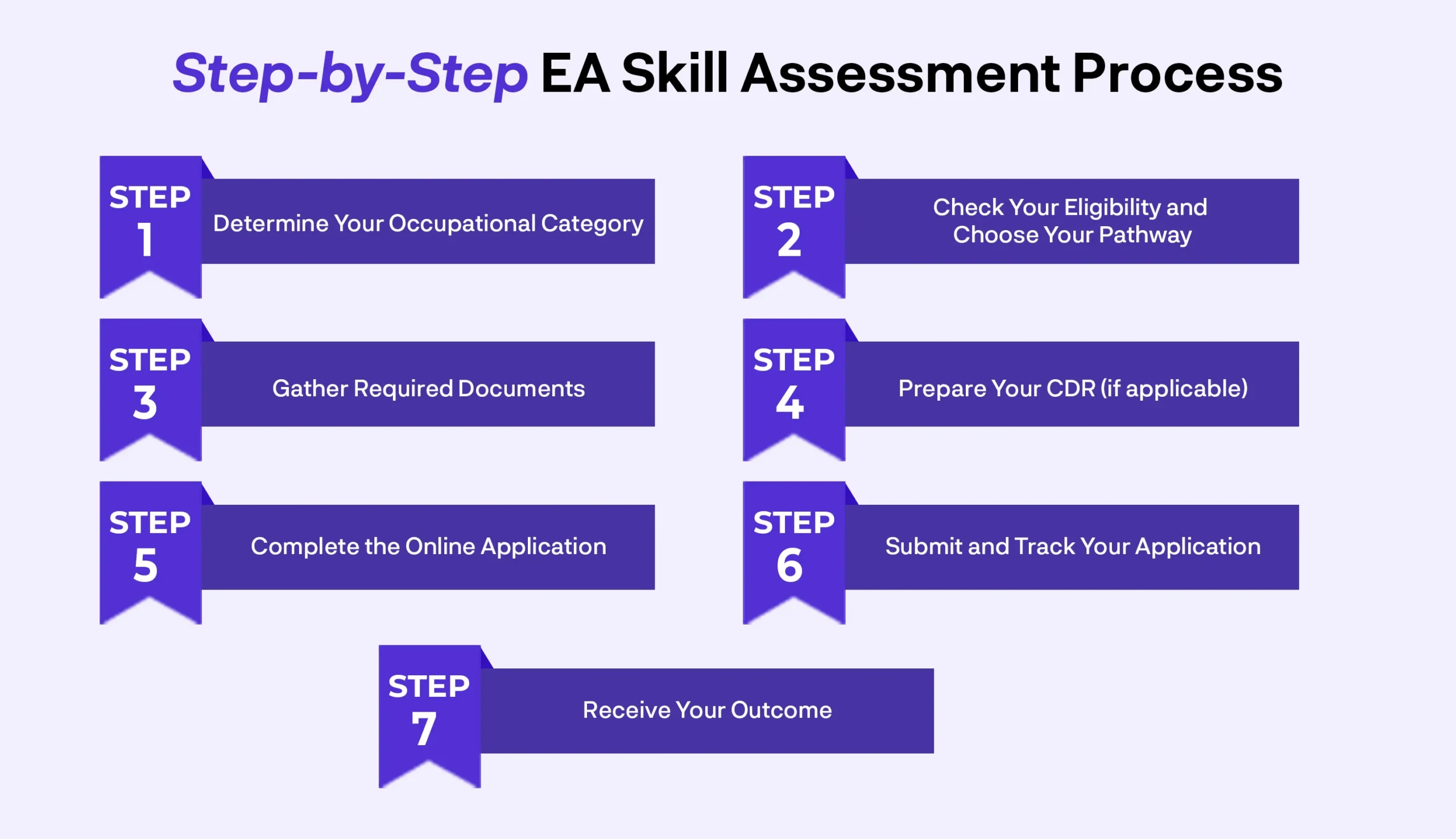 Step-by-Step EA Skill Assessment Process
Understanding the process helps you prepare better and avoid common mistakes. The following are the actions you need to take are :-
Step 1: Determine Your Occupational Category
First, identify whether you qualify as a Professional Engineer, Engineering Technologist, Engineering Associate, or Engineering Manager. This depends on your degree level and work experience. Your occupational category determines which competency standards you must demonstrate.
Step 2: Check Your Eligibility and Choose Your Pathway
Visit the EA website and confirm your occupation appears on their current list of 31 approved engineering occupations. Verify which assessment pathway matches your qualification. Verify whether your degree is recognized by Accord or whether a CDR is required.
Step 3: Gather Required Documents
Collect all necessary documents including degree certificates, academic transcripts, passport, employment reference letters, and CPD records. Ensure all documents are high-quality color scans. Non-English documents need certified translations from authorized translators.
Step 4: Prepare Your CDR (if applicable)
If following the CDR pathway, write three career episodes that showcase your engineering work. Each episode should be between 1000 and 2500 words written in first-person narrative style. Focus on your individual contribution to projects, not general descriptions. Every paragraph should be numbered for cross-referencing in your summary statement.
The team at CDR Australia Migration specializes in guiding engineers through CDR preparation. They help structure career episodes correctly, ensure all 16 competency elements are covered, and eliminate plagiarism risks that lead to automatic rejection.
Step 5: Complete the Online Application
Create an account on the EA myPortal system. Provide accurate information on your application form. Select your nominated occupation from the dropdown list of 31 engineering occupations. Upload all required documents in PDF format with logical file names. Pay the assessment fee through the secure online portal. Current fees start at approximately AUD 410 for Accord pathways and AUD 1,020 for CDR applications.
Step 6: Submit and Track Your Application
After submission, EA reviews your application thoroughly. Processing times typically range from 12 to 20 weeks, though complex cases may take longer. You may always check the status of your application using your myPortal account. EA may request additional information if gaps are identified in your submission.
Step 7: Receive Your Outcome
EA emails you the assessment outcome along with your official outcome letter. A positive assessment confirms your qualifications meet Australian standards, allowing you to proceed with visa applications. If your application is unsuccessful, EA explains the reasons and you have options to request a review or appeal the decision.
What Documents Do You Need for EA Skill Assessment?
Getting your documentation right is critical for success. Missing or incorrect documents cause delays and potential rejection. Here is a complete checklist:
Identity Documents:
- Current passport biographical page
- Recent passport-sized photograph (specific dimensions apply)
- Birth certificate
- Marriage certificate or name change documents (if applicable)
Academic Qualifications:
- Degree certificates or award certificates
- Complete academic transcripts showing all subjects and grades
- Course curriculum or syllabus documents
- Medium of instruction certificate (if degree was not taught in English)
English Language Proof:
- IELTS Academic (minimum 6.0 in each component)
- PTE Academic (minimum 50 in each component)
- TOEFL iBT (minimum scores as per EA requirements)
- Other accepted tests with equivalent scores
Employment Evidence (for skilled employment claims):
- Reference letters on official company letterhead
- Letters must include company name, address, and contact details
- Your work title and the beginning and ending dates of your employment
- Detailed description of duties and responsibilities performed
- Company stamp or seal (where applicable)
- Supporting documents like payslips, tax returns, or employment contracts
CDR Components (for CDR pathway applicants):
- Three career episodes (each 1000-2500 words)
- Summary statement using the official EA template
- CPD list covering at least 12 months of activities
- Updated curriculum vitae (maximum three pages)
All documents not originally in English must have certified translations. It is necessary to submit both the original document and its English translation. Use only authorized translators whose credentials are recognized.
Typical Obstacles Engineers Face and Solutions
Many engineers encounter obstacles during their EA skill assessment journey. You can better prepare and steer clear of costly errors by being aware of these obstacles.
Challenge 1: Writing Effective Career Episodes
Creating technical content in simple English proves difficult for many engineers. Career episodes must clearly show your individual engineering contribution without being overly technical or too simplified. Generic project descriptions fail to demonstrate personal competency.
Solution: Focus on what you personally designed, analyzed, calculated, and implemented. Write in first-person active voice throughout. Describe your engineering decisions and their technical justification. Professional CDR writing services at CDR Australia Migration have helped thousands of engineers craft compelling career episodes that EA assessors approve.
Challenge 2: Plagiarism Detection and Rejection
EA employs sophisticated plagiarism detection software on all submissions. Even unintentional similarities to online samples, templates, or other CDRs result in immediate rejection and potential ban from reapplying.
Solution: Write everything in your own words based on actual work you completed. Never copy from online samples or use templates for content. Paraphrase technical concepts in your unique style. Have your CDR professionally checked for plagiarism before submission.
Challenge 3: Incomplete or Improper Documentation
Missing documents, poor quality scans, incorrect certifications, or missing translations trigger automatic requests for additional information or outright rejection.
Solution: Follow EA’s document checklist precisely. Scan all documents in high-quality color. Verify each document is properly certified by authorized personnel. Double-check translations are complete and from accredited translators. Create a verification checklist before submission.
Challenge 4: Incorrect Occupational Category Selection
Choosing the wrong occupational category means demonstrating competencies for the wrong standard. This leads to assessment failure even if your engineering work is excellent.
Solution: Carefully review the descriptions of Professional Engineer, Engineering Technologist, Engineering Associate, and Engineering Manager. Match your qualification level and work experience to the appropriate category. When uncertain, consult with migration experts who understand EA requirements.
Challenge 5: Missing Competency Elements
EA requires demonstration of all 16 competency elements for your category. Missing even one element results in a negative outcome.
Solution: Use the official summary statement template provided by EA. Map every competency element to specific numbered paragraphs in your career episodes. Ensure comprehensive coverage across all three episodes. Professional reviewers at CDR Australia Migration verify complete competency coverage before submission.
Challenge 6: Extended Processing Times
An assessment can be stressful to wait a few months after what is already a stressful visa process or a job prospect.
Remedy: Submit your applications early enough before any deadline. Do not rush and submit incomplete or incorrect applications as this will occasion delays due to information requests. Look at the fast-track option of EA in case you need to do a rushed migration.
Practical Tips for a Successful EA Skill Assessment in 2026
These proven strategies increase your chances of receiving a positive assessment on your first attempt:
1) Start Your Preparation Early
Begin gathering documents and preparing your CDR at least six months before you plan to submit. Rushing leads to mistakes and incomplete applications. Quality preparation takes time.
2) Read the MSA Booklet Thoroughly
Download and study the Migration Skills Assessment Booklet from EA’s website. This official guide contains exact requirements, competency standards, and formatting rules. Understanding these guidelines prevents basic errors.
3) Write Career Episodes from Real Projects
Base each career episode on actual engineering work you personally completed. Describe specific technical problems you solved, calculations you performed, and decisions you made. Include measurable outcomes and project impacts.
4) Use Simple, Professional Language
Write in clear English that any engineer can understand. Avoid unnecessary jargon while maintaining technical accuracy. Short sentences and logical flow improve readability for EA assessors.
5) Number Every Paragraph
Number each paragraph in your career episodes sequentially. This allows precise cross-referencing in your summary statement and helps assessors locate competency demonstrations quickly.
6) Demonstrate All 16 Competency Elements
Ensure your three career episodes collectively demonstrate every required competency element for your occupational category at least once. Use the official summary statement template to map each element.
7) Maintain Absolute Honesty
EA verifies information through various means. False claims about qualifications, employment, or project involvement lead to permanent bans. Present only genuine, verifiable information.
8) Proofread Multiple Times
Spelling errors, grammar mistakes, and formatting inconsistencies create poor impressions. Review your entire CDR multiple times. Consider professional editing services for final polish.
9) Keep Complete Backups
Save copies of everything you submit. You may need to reference these documents during visa applications or if EA requests clarification.
How Professional CDR Services Help You Succeed
The EA skill assessment demands precision, technical clarity, and perfect adherence to guidelines. Small errors create big problems, costing you time, money, and migration opportunities.
Professional services like CDR Australia Migration provide comprehensive support throughout your assessment journey. They offer expert CDR writing assistance from engineers who understand EA’s competency standards. Their plagiarism checking ensures your content is completely original and safe from automatic rejection.
Document preparation services verify you have everything EA requires in the correct format. Professional reviewers examine your application before submission, catching errors and gaps you might miss. They help select the correct occupational category and ANZSCO code for your situation.
The value of professional assistance shows in success rates. Experienced CDR writers know what EA assessors look for in career episodes. They understand how to demonstrate technical competency while maintaining simple, clear language. Their guidance helps you present your engineering experience effectively.
A lot of engineers give DIY CDR and fail because of the plagiarism alert, the lack of competency components, or poor organization. Reapplication implies extra costs, a further delay, and uncertainty. Professional assistance can do it first time, and you will not have to experience such failures.
In addition to the CDR preparation, these services will assist in document collection, translation process, and filing. They keep informed about the changes in policy and 2026 requirements in EA. This experience is very useful where the requirements are complicated or vague.
The cost of investing in professional CDR services is normally lower than the cost of reapplication and definitely lower than the opportunity cost of not migrating on time. Expert help offers solace and is the best way to ensure maximum approval to the Australian migration engineers who are serious about the migration.
Conclusion: Your Path to Australian Engineering Success
Warring engineering opportunities in Australia are open to the engineers australia skill assessment. Although the process has particular demands and problems, good preparation will result in success. Knowing the right route to take given your qualifications, compiling relevant documents and selling your skills are some of the critical actions.
To engineers on the CDR pathway, speed is not as important as quality. Write down definite career events that reveal your actual engineering work. Demonstrate all the necessary competencies to show. Make sure that your application is free of plagiarism and it is professionally formatted.
Bear in mind that such an evaluation will confirm that you can play a significant role in the engineering career in Australia. Consider it in the same professional manner where you give it attention to detail as in the application to engineering projects. Regardless of whether you prepare yourself or a professional councillor, the greater the preparation, the higher the chances that you will be positively assessed.
Your EA skill assessment would be the first step in the process of Australian migration. Get this base and the rest of your migration process is going to occur more easily. To help you with your engineers australia skill assessment, we have skilled personnel at CDR Australia Migration who are available to help you achieve success in the year 2026 and beyond.