CDR Australia Migration

Competency Demonstration Report Writing Service

Engineers Australia CDR Checklist Before Submission 30 Things to Verify

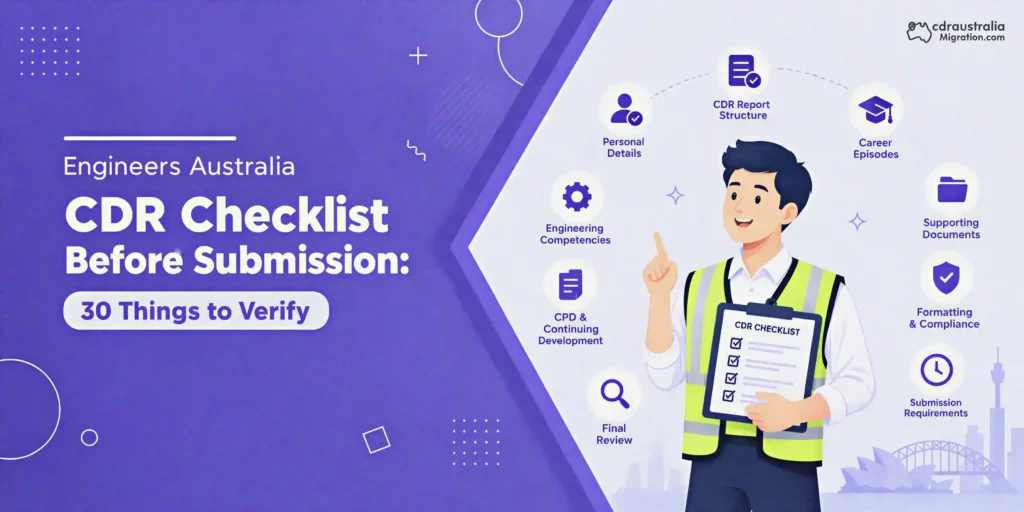
Engineers Australia CDR Checklist Before Submission: 30 Things to Verify

Before you log into the online portal and submit your files, systematic verification is essential. This practical 30-point guide serves as your comprehensive CDR submission checklist, Engineers Australia CDR checklist  and CDR pre-submission checklist. By reviewing every requirement line by line, you can ensure that your application is accurate, compliant, and ready for submission. The 30 Point Engineers Australia CDR Checklist 1. Confirm You Are Using the Correct Assessment Pathway What to verify: Check whether your engineering qualifications require the Competency Demonstration Report (CDR) pathway or an Accredited pathway (such as Washington Accord, Sydney Accord, Dublin Accord, or an Australian accredited degree). Why it matters: Applying under the CDR pathway when your degree is covered under an International Accord wastes time and money. Conversely, submitting an Accord application for a non-accredited program results in immediate rejection or re-direction. Quick check: Verify your institution and program accreditation status against the official International Engineering Alliance or Engineers Australia accredited list before lodging. 2. Verify the Correct Engineering Occupational Category What to verify: Ensure you have selected the appropriate occupational category from the four recognized by Engineers Australia: Professional Engineer, Engineering Technologist, Engineering Associate, or Engineering Manager. Why it matters: The Stage 1 Competencies and Summary Statement template differ significantly across categories. Selecting the wrong category invalidates your Summary Statement mapping. Quick check: Match your academic background (e.g., 4-year Bachelor’s degree for Professional Engineer, 3-year Bachelor of Technology for Engineering Technologist, 2-year Advanced Diploma for Engineering Associate) with the appropriate category guidelines. 3. Verify the Nominated Engineering Occupation (ANZSCO Code) What to verify: Confirm that your nominated ANZSCO occupation code (e.g., Civil Engineer 233211, Mechanical Engineer 233512) directly reflects your actual engineering specialization and career evidence. Why it matters: Engineers Australia assesses your technical work and academic background against the specific duties associated with the selected ANZSCO code. Quick check: Review the ANZSCO description for your target code and ensure your Career Episodes clearly feature those core technical responsibilities. 4. Check Your Personal Information What to verify: Double-check your legal full name, date of birth, gender, passport number, and contact details entered into the Engineers Australia portal. Why it matters: Any typographic error in your personal details will cause discrepancies on your final Migration Skills Assessment outcome letter. Quick check: Place your passport bio-page next to your online application screen and verify character by character. 5. Make Sure All Application Details Are Consistent What to verify: Cross-check your name spelling, dates of study, graduation dates, and employment dates across your CV, degree certificates, transcripts, Career Episodes, and online portal forms. Why it matters: Conflicts in dates or job titles raise concerns during assessment and trigger mandatory requests for clarification. Quick check: Draft a simple master timeline of your education and employment to confirm that every document aligns perfectly. 6. Passport or Identification Document What to verify: Ensure you have a high-resolution, full-color scan of your valid passport bio-page (showing your photo, signature, and personal details). Why it matters: Unclear or black-and-white identification scans are rejected during initial document checks. Quick check: Verify that your passport is current and the scan clearly displays all text, machine-readable zones, and visual borders. 7. Recent Passport-Style Photograph What to verify: Check whether a current, passport-size color photograph meeting standard passport guidelines is ready for upload where required by the portal. Why it matters: Providing an outdated or blurry image can delay processing during identity checks. Quick check: Use a clear, high-contrast, plain-background photo taken within the last six months. 8. Degree Certificate / Testamur What to verify: Ensure you have high-resolution color scans of your original degree certificates, diplomas, or testamurs for all completed higher education engineering qualifications. Why it matters: Your degree certificate serves as primary legal evidence of your formal academic achievements. Quick check: Confirm that the degree award title, university name, and date of graduation on the scan match your CV exactly. 9. Academic Transcripts What to verify: Upload complete academic transcripts covering every semester or academic year, showing all subjects taken, grades received, and course credit details. Why it matters: Engineers Australia reviews your course subjects to verify the underlying theoretical engineering knowledge supporting your degree. Quick check: Ensure no transcript pages or back-page grading keys are missing from your PDF files. 10. Change-of-Name Documents (If Applicable) What to verify: If your current passport name differs from the name on your academic transcripts or certificates, include official evidence (such as a marriage certificate, deed poll, or gazette notification). Why it matters: Assessor verification fails if academic records cannot be legally linked to your passport identity. Quick check: Confirm that official, legal change-of-name documents are uploaded alongside your identity files. 11. Registration or Licensure Documents (Where Applicable) What to verify: Gather evidence of professional engineering registrations, state licenses, or membership certificates from recognized professional bodies if held. Why it matters: Professional licensing provides supplementary evidence of your standing within the engineering community. Quick check: Verify that active registration certificates are valid and included in your document repository. 12. English Language Evidence What to verify: Ensure you have valid results from an approved test—such as IELTS (Academic or General Training), PTE Academic, or TOEFL iBT—or meet official exemption criteria (such as holding a passport from an exempt country or completing an accredited Australian engineering degree). Why it matters: Applications without valid English proficiency test results (or proven exemption) cannot proceed to technical assessment. Quick check: Confirm that your test scores meet current minimum band thresholds (e.g., 6.0 in each band for IELTS, 50 in each module for PTE Academic) and are within the recognized validity period at the time of submission. 13. Certified/Official Translations Where Required What to verify: Any document not originally issued in English must be accompanied by a complete, official English translation performed by a certified professional translator. Why it matters: Engineers Australia assessors cannot evaluate non-English transcripts, employment letters, or degree certificates. Quick check: Verify that both the original non-English document and the signed/stamped English translation are uploaded together. 14.

Engineers Australia CDR Checklist Before Submission: 30 Things to Verify Read More »
CDR Report for Engineers Australia Step-by-Step Guide

CDR Report for Engineers Australia: Step-by-Step Guide

Preparing a CDR Report for Engineers Australia is one of the most critical milestones for international engineers seeking to migrate to Australia. A Competency Demonstration Report (CDR) serves as the primary gateway for qualification recognition when an applicant’s engineering degree is not automatically accredited under international agreements such as the Washington, Sydney, or Dublin Accords. This step-by-step guide walks you through every component of an Engineers Australia CDR report, detailing specific requirements, proper formatting, effective writing strategies, and common pitfalls to avoid. So what is the CDR Report for Engineers Australia? A  CDR Report for Engineers Australia, short for Competency Demonstration Report is an official technical portfolio submitted to Engineers Australia to assess the qualifications and competencies of international engineers. Engineers Australia is the designated assessing authority for engineering occupations under Australia’s Skilled Migration Program. Purpose of the CDR Pathway The primary purpose of a CDR report for migration is to provide an equitable assessment pathway for engineers whose qualifications were obtained from non-accredited institutions or programs outside international accords. Through the CDR pathway, Engineers Australia evaluates whether your engineering education and professional work experience align with the competency standards established for specific occupational categories in Australia. Occupational Categories Assessed by Engineers Australia Engineers Australia assesses applicants under four distinct occupational categories: Professional Engineer Focuses on engineering synthesis, systemic design, innovation, and overall project responsibility (typically requires a 4-year bachelor’s degree in engineering). Engineering Technologist Focuses on applying established engineering technologies, managing technical operations, and adapting systems (typically requires a 3-year degree in engineering technology). Engineering Associate Focuses on practical implementation, technical testing, codes of practice, and plant maintenance (typically requires a 2-year advanced diploma or associate degree). Engineering Manager Focuses on high-level strategic planning, resource allocation, financial management, and operational leadership across engineering projects (requires extensive management experience following an engineering background). The goal of your CDR is not to show what your team accomplished, but to present direct, verifiable evidence of what you personally designed, analyzed, calculated, and executed. Who Needs a CDR Report for Engineers Australia? Not every international engineer moving to Australia needs to complete a CDR. Determining your correct assessment pathway before starting your application saves considerable time and effort. Who MUST Submit a CDR? You are required to submit a CDR if: Your undergraduate engineering qualification was awarded in a country that is not a signatory to an international engineering accord. Your qualification was awarded in an accord signatory country, but your specific program was not accredited at the time of your graduation. Your qualification falls outside the scope of accredited structural pathways (e.g., holding a non-engineering bachelor’s degree paired with a master’s degree that does not meet standalone accreditation standards). Who Does NOT Need a CDR? You generally do not need to prepare a CDR if your qualification is fully recognized under one of the following international agreements: Washington Accord: For Professional Engineering qualifications. Sydney Accord: For Engineering Technologist qualifications. Dublin Accord: For Engineering Associate qualifications. Note: Always verify the accreditation status of your specific university program and graduation year via the official International Engineering Alliance or Engineers Australia portals prior to starting your report. CDR Report Requirements To complete a successful CDR report submission, you must assemble both technical writing components and non-technical supporting documentation. Missing or inconsistent documents can lead to assessment delays or rejection. Key Documentation Requirements 1. Curriculum Vitae (CV) / Resume A comprehensive document detailing your educational background and full work history. Your CV must explain any gaps in employment or study exceeding 6 months. 2. Continuing Professional Development (CPD) A structured record demonstrating how you have kept your technical skills and knowledge up to date after completing your engineering degree. 3. Three Career Episodes Distinct, detailed narrative accounts of specific engineering projects or roles that illustrate your technical problem-solving capabilities. 4. Summary Statement A critical matrix linking specific elements of engineering competency to paragraph numbers within your Career Episodes. 5. English Language Competency Valid results from accepted tests such as IELTS, PTE Academic, or TOEFL iBT, unless you meet specific exemption criteria. 6. Primary Supporting Documents High-resolution scans of your passport identity page, official degree certificates, academic transcripts, and official proof of employment. CDR Report Structure Understanding the CDR report structure helps maintain logical balance and consistency across your entire portfolio. Each section serves a distinct role in proving your competency to the assessor. CDR Component Primary Purpose What the Applicant Must Demonstrate CPD Record Shows ongoing technical learning Attendance at courses, seminars, workshops, self-study, and technical literature reviews. Career Episode 1 Demonstrates application of engineering knowledge in a real-world scenario Application of core technical knowledge, problem-solving, design, and calculations. Career Episode 2 Demonstrates a distinct project, work period, or complex task Technical leadership, analysis, compliance with safety/environmental standards. Career Episode 3 Focuses on another technical engineering project or academic endeavor Advanced technical skills, team collaboration, project execution, and outcomes. Summary Statement Maps demonstrated work to EA Stage 1 Competencies Direct cross-referencing between standard competency units and specific narrative paragraphs. Every component must align seamlessly with the others. For example, dates and roles cited in your Career Episodes must match the timelines on your CV and employment reference letters. CDR Report Format Following the correct CDR report format is essential. Engineers Australia evaluators process thousands of applications annually; non-standard structures, missing paragraph numbers, or informal formatting can negatively affect how your file is reviewed. Essential Formatting Rules 1. Strict Paragraph Numbering Every paragraph within your three Career Episodes must be systematically numbered for cross-referencing in the Summary Statement. Episode 1: Paragraphs CE 1.1, CE 1.2, CE 1.3, etc. Episode 2: Paragraphs CE 2.1, CE 2.2, CE 2.3, etc. Episode 3: Paragraphs CE 3.1, CE 3.2, CE 3.3, etc. 2. First-Person Narrative Voice All Career Episodes must be written in the first-person singular active voice (“I designed,” “I calculated,” “I investigated,” “I recommended”). Avoid writing in the third person or using passive phrasing like “The team decided” or “It was executed.” 3. Length Constraints Career Episodes should

CDR Report for Engineers Australia: Step-by-Step Guide Read More »

Does Engineers Australia Check CDR Reports for Plagiarism?

Does Engineers Australia Check CDR Reports for Plagiarism?

If you’re preparing your Competency Demonstration Report (CDR), you’ve probably asked yourself: Does Engineers Australia actually check CDR reports for plagiarism? The short answer: Yes. Originality is a core requirement of the Migration Skills Assessment (MSA), and Engineers Australia treats plagiarism as a serious ethical breach, not a minor formatting issue. This article covers: What Engineers Australia’s plagiarism checks actually mean for your application. How text similarity differs from confirmed plagiarism. Actionable steps to ensure your CDR stands entirely on its own merit. Are CDR Reports Checked for Plagiarism? Yes. Engineers Australia’s Migration Skills Assessment guidelines explicitly forbid plagiarism and applicants must declare that their Career Episodes and Summary Statement are their own original work. A CDR that presents someone else’s writing, ideas or engineering experience as your own can be treated as an ethical breach, which can lead to rejection and a period during which you cannot reapply. This isn’t a rumour spread by CDR consultants , it comes directly from how Engineers Australia frames its assessment process. According to Engineers Australia’s own guidance for migration skills assessment applicants, there are important ethical standards that must be followed when applying, and engaging in plagiarism, defined as presenting work completed by others as your own or copying other people’s words , is expressly forbidden. This includes having a third party write your Career Episodes or Summary Statement on your behalf. A few things follow from this: •Originality genuinely matters. A CDR is meant to demonstrate your engineering competencies through your documented experience. If large sections are copied, the assessor cannot verify that the underlying competency actually belongs to you. •Copied material undermines credibility. Even technically accurate content loses its value if it isn’t demonstrably yours, because the entire purpose of the CDR is to evidence personal, first-hand engineering practice. •Similarity is not automatically plagiarism. Text-matching tools can flag overlapping phrases for many innocent reasons which include shared technical terminology, industry standards, or common report structures. What matters is whether the substance of the work i.e. your project description, your decisions, your contribution has genuinely been copied or misrepresented as your own. •Assume scrutiny, not leniency. Given how many applicants now use CDR samples, templates, and AI writing tools, it’s realistic to assume your submission could be reviewed for originality in some form. Writing with that expectation in mind is simply good practice, regardless of the exact detection method used. If you want a second set of eyes on your report’s originality before you submit, our CDR plagiarism checking and removal service reviews Career Episodes and Summary Statements for exactly these issues. What Is a CDR Plagiarism Check? A CDR plagiarism check is essentially a review process which is automated, manual, or both that looks for content in your CDR that hasn’t originated from you. In practice, this generally involves looking for: •Copied phrases or sentences lifted directly from websites, textbooks, journal articles or engineering standards •Reused passages from CDR samples, whether free ones found online or samples used as writing templates •Unattributed material where information from an external source is presented without acknowledging where it came from •Similarities with publicly available content including blog posts, technical guides or previously published CDR examples •Similarities with other applicant’s CDRs particularly when two engineers who worked at the same company submit suspiciously similar Career Episodes •Inappropriate reuse of someone else’s Career Episode such as adapting a colleague’s or friend’s approved CDR •Copied technical descriptions where a process, calculation, or system description is duplicated from a manual or specification sheet rather than described in the applicant’s own words It’s worth being cautious here: while it’s reasonable to assume Engineers Australia takes originality seriously enough to review submissions for it, there is no publicly confirmed list of specific software or an exact internal procedure that EA uses for every application. Claims that name a particular plagiarism-detection product as officially used by Engineers Australia should be treated as unverified unless linked to an authoritative EA source. What’s confirmed and consistent across EA’s own applicant guidance is the policy, plagiarism is forbidden and carries consequences and not the specific detection mechanics. How Does CDR Plagiarism Checking Work? Whether performed by Engineers Australia, an assessor, or a review service you engage yourself, a plagiarism or originality check generally follows a similar logical process: 1 Text comparison: Your document is compared against a database of existing content, which may include web pages, academic sources and previously submitted reports. 2 Identification of matching or similar passages: The check highlights sections of text that closely resemble existing material. 3 Review of context: A human reviewer (rather than software alone) looks at why the match exists. Is it a shared technical term, a standard formula, or genuinely copied prose? 4 Assessment of originality: The reviewer forms a judgement about whether the matched content reflects legitimate overlap or a real originality concern. 5 Potential consequences where plagiarism is established: If a passage is judged to be improperly copied or misrepresented as the applicant’s own work, this can affect the outcome of the assessment. An important nuance: Engineering reports naturally contain overlapping language. Standard terminology, Australian and international codes and standards, common formulas, industry-specific phrasing and even typical report structures (Introduction, Background, Personal Engineering Activity, Summary) will understandably create some degree of text similarity between unrelated CDRs. This kind of overlap is expected and is not by itself evidence of plagiarism. The concern arises when substantial, non-generic passages such as detailed project narratives, specific technical decisions or personal reflections are duplicated from another source. What Is a CDR Similarity Report? A similarity report is a document generated by text-comparison software that shows which portions of your CDR overlap with other indexed sources. It typically highlights matched text and may express the overall overlap as a percentage. Here’s what’s important to understand about a CDR similarity report: •Matching text is not automatically plagiarism. It simply shows that certain words or phrases also appear elsewhere. •A similarity score alone doesn’t prove misconduct. Two reports can

Does Engineers Australia Check CDR Reports for Plagiarism? Read More »

How Does the CDR Work? Complete Engineers Australia CDR Process Guide

How Does the CDR Work? Complete Engineers Australia CDR Process Guide

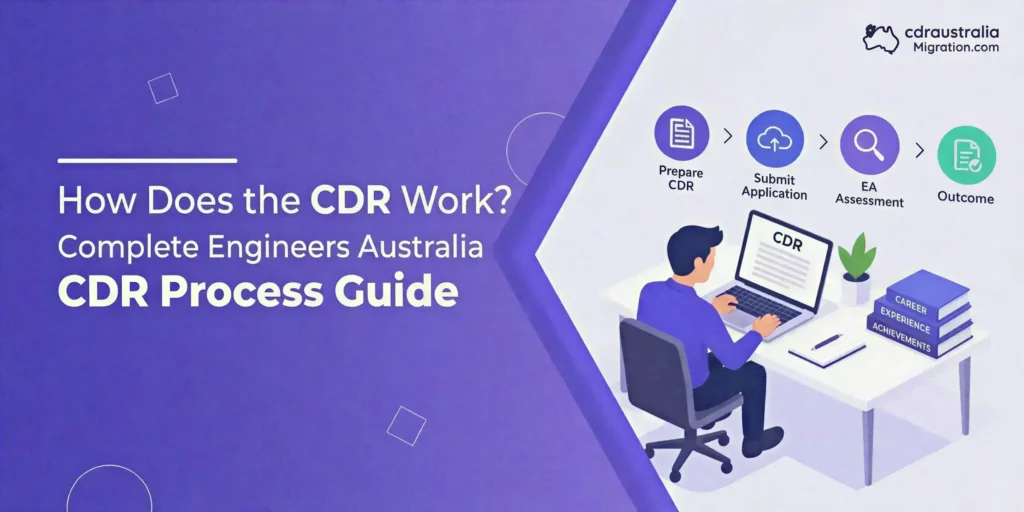
A Competency Demonstration Report (CDR) is a document-based technical portfolio evaluated by Engineers Australia (EA) to assess whether an internationally qualified engineer possesses technical competencies equivalent to Australian engineering standards. The CDR process involves gathering academic and identity documents, documenting professional development, writing three detailed Career Episodes, mapping competencies in a Summary Statement and submitting the application online for official evaluation. Securing a positive Engineers Australia CDR process outcome is a core requirement for skilled migration visas managed by the Australian Department of Home Affairs. This detailed guide breaks down how does the CDR work, the essential CDR requirements, step-by-step submission instructions, evaluation criteria, and actionable tips to avoid costly delays. What Is a CDR? A Competency Demonstration Report (CDR) is a technical portfolio that internationally qualified engineers use to prove their engineering knowledge, skills, and practical experience align with Australian standards. Purpose: To demonstrate that your undergraduate engineering qualifications and work experience match the competencies defined for specific engineering occupational categories in Australia. Assessing Authority: Engineers Australia (EA) is the designated assessing authority appointed by the Australian Government to conduct engineering skills assessments for skilled migration. Why it is necessary: Australia has international accord agreements (such as the Washington Accord, Sydney Accord, and Dublin Accord) with select countries. If your engineering degree was earned from a non-accredited institution or a nation outside these accords, the CDR pathway provides the custom, evidence-based route to validate your skills. Through a CDR, you demonstrate engineering competencies by providing concrete evidence of problem-solving, technical decision-making, engineering calculations, and professional leadership. How Does the CDR Work? The CDR evaluation process evaluates your engineering knowledge through a step-by-step submission workflow: Understanding how these stages connect ensures you avoid unnecessary delays or formal requests for information (RFIs) from Engineers Australia. Who Needs the Engineers Australia CDR Pathway? You will need to submit a CDR application if you meet the following conditions: You hold an engineering qualification from an institution that is not accredited under an recognized international agreement (Washington Accord, Sydney Accord, or Dublin Accord). Your qualification is from an accord-signatory nation, but was completed before the country became a signatory or during a non-accredited timeframe. You are applying under a specific ANZSCO Occupation Code that requires customized demonstration of practical competency. Note: Qualifications, migration policies, and Engineers Australia rules are updated periodically. Always verify your eligibility and check the latest official Engineers Australia Migration Skills Assessment (MSA) Booklet before starting your application. CDR Requirements To build a compliant application, you must gather personal identification, academic history, and technical portfolio components. Component / Requirement Description & Details Identity Documents Valid passport, current passport-sized photo, official name-change documents (if applicable), and updated Curriculum Vitae (CV/Resume). Academic Records Degree certificates, official academic transcripts, and course completion letters. (Official English translations are needed for non-English documents). English Language Proficiency Valid test scores from IELTS (Academic or General), PTE Academic, or TOEFL iBT. Exemptions apply to native English speakers from specified countries. CPD (Continuing Professional Development) A concise, single-page summary list showing how you have kept your engineering knowledge up to date post-graduation. 3 Career Episodes Three detailed narrative essays describing distinct engineering projects or tasks where you personally applied your engineering skills. Summary Statement A structured cross-referencing document that links specific paragraphs in your Career Episodes to Engineers Australia’s competency units. Employment Evidence Reference letters, pay slips, tax returns, and official job descriptions if claiming work experience or writing episodes based on professional roles. CDR Assessment Process Explained Step by Step Let us break down the CDR process Engineers Australia specifies into 9 sequential steps. Step 1: Determine Your CDR Pathway Before writing, confirm which occupational category matches your qualification: Professional Engineer (4-year Bachelor degree equivalent) Engineering Technologist (3-year Bachelor degree equivalent) Engineering Associate (2-year Advanced Diploma or Associate degree equivalent) Engineering Manager (Requires extensive leadership experience in engineering) Match your background to the appropriate ANZSCO Code listed on the official skilled occupation list. Step 2: Create and Prepare Your Engineers Australia Application Register for a unique Engineers Australia ID (EA ID) on the official online portal. Verify your personal details, collect identity proof, update your CV to reflect accurate timelines, and prepare official English test results. Step 3: Prepare Your CPD The Continuing Professional Development (CPD) statement demonstrates your ongoing technical growth. Format it as a simple list covering: Post-graduate academic studies Short courses, seminars, and workshops attended Technical conferences and presentations Reading of engineering journals or literature Volunteer work in technical societies Step 4: Write Your Career Episodes The three Career Episodes form the core of your report. Each episode focuses on a specific engineering project or period of activity. Format: Written in first-person singular narrative (“I designed,” “I calculated,” “I evaluated”). Word Count: Generally 1,000 to 2,500 words per episode. Structure: Introduction: Chronology, dates, location, organization, and role. Background: Context of the overall project, objectives, and organizational chart showing your position. Personal Engineering Activity: Technical work, calculations, software used, challenges encountered, design choices, and problem-solving steps. Summary: Overview of project outcomes and your specific contributions. Step 5: Prepare the Summary Statement The Summary Statement bridges your Career Episodes and Engineers Australia’s competency standards. It lists the competency elements for your occupational category and requires you to cross-reference paragraph numbers from your Career Episodes (e.g., CE 1.2, CE 2.4) as evidence. Only one Summary Statement is required for all three Career Episodes combined. Step 6: Review Your Complete CDR Conduct a thorough quality review: Check that all narrative paragraphs are clearly numbered (e.g., Section 1.1, Section 1.2). Ensure technical terms, project outcomes, and dates are consistent across your CV, Career Episodes, and reference letters. Check that no content is copied or plagiarized. Step 7: Submit Your CDR Application Log into the Engineers Australia online portal, select the Migration Skills Assessment (MSA) service, upload your documents in PDF format, pay the required assessment fee, and submit. You can also opt for Fast Track processing if available at the time of submission. Step 8: Engineers Australia Evaluates Your CDR An

How Does the CDR Work? Complete Engineers Australia CDR Process Guide Read More »

CDR vs Accredited Qualification Pathway: Which Engineers Australia Assessment Is Right for You?

CDR vs Accredited Qualification Pathway: Which Engineers Australia Assessment Is Right for You?

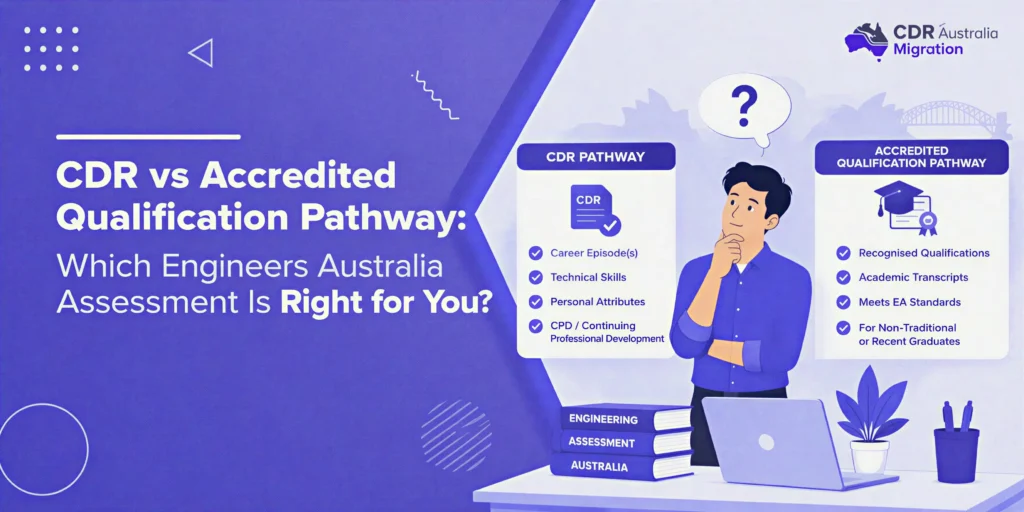
Engineers Australia offers two primary routes for migration skills assessments: the Accredited Qualification Pathway and the Competency Demonstration Report (CDR) pathway. If your engineering degree is recognized under an international accord or directly accredited by Engineers Australia, your qualification pathway is straightforward. However, if your degree was obtained from a non-accredited institution, you must demonstrate your engineering knowledge and practical experience through the CDR pathway Engineers Australia sets out. This guide provides a comprehensive comparison of both pathways, detailing eligibility rules, document requirements, and step-by-step procedures to help you identify the right stream for your migration journey regarding CDR vs Accredited Qualification Pathway. What Is the Engineers Australia CDR Pathway? The Competency Demonstration Report (CDR) pathway is a technical assessment process designed for engineers holding non-accredited or unrecognized qualifications. CDR stands for Competency Demonstration Report, a detailed portfolio of documents where you showcase how your engineering knowledge, practical skills, and professional experience match Australian standards. Engineers Australia relies on the Engineers Australia CDR pathway to assess whether an applicant’s undergraduate qualification and post-graduate engineering experience meet the core competencies required for practice in Australia. Rather than focusing solely on the name or syllabus of your university degree, the CDR pathway for engineers evaluates how you have applied engineering principles, solved complex technical problems, and adhered to professional safety standards in real-world scenarios. Commonly used by international engineering graduates from countries outside major educational accords, this pathway offers a clear route to benchmark engineering qualifications against Australian standards. What Is the Accredited Qualification Pathway? The Accredited Qualification Pathway is a streamlined skills assessment stream for applicants holding an accredited engineering qualification. In this context, “accredited” means that the engineering program has been formally evaluated and recognized either directly by Engineers Australia or through an international engineering agreement. Engineers Australia recognizes qualifications under three key international agreements, known collectively as the International Engineering Alliance (IEA) Accords: Washington Accord: Applies to professional engineering degree programs (typically 4-year Bachelor of Engineering degrees). Sydney Accord: Applies to engineering technologist degree programs (typically 3-year Bachelor of Engineering Technology degrees). Dublin Accord: Applies to engineering technician qualifications (typically 2-year Associate Degrees or Advanced Diplomas in engineering). If your degree was completed at an accredited institution, in an accredited country, and during or after the specific year the country became a signatory to the accord, Engineers Australia recognizes your academic qualification directly. You generally do not need to submit written career episodes or a summary statement under this stream. Note: Holding an engineering degree from an accord-signatory country does not automatically mean your specific program is accredited. Accreditation depends on the exact university, program title, and the year you graduated. CDR vs Accredited Qualification Pathway: Key Differences To help you compare both streams at a glance, the table below breaks down the structural differences between the CDR pathway and the Accredited Qualification Pathway. Factor CDR Pathway Accredited Qualification Pathway Qualification Recognition Designed for non-accredited or unrecognized qualifications. Designed for qualifications formally recognized under the Washington, Sydney, or Dublin Accords (or Australian accredited programs). Typical Applicant Internationally educated engineers whose degrees are not covered by an international agreement. Engineering graduates from accredited Australian universities or accord-signatory institutions. Competency Evidence High focus on written evidence demonstrating practical application of engineering competencies. High focus on institutional accreditation and official academic transcripts. CDR Requirement Mandatory (3 Career Episodes, Summary Statement, CPD list). Not Required. Academic Documentation Degree certificate, transcripts, and syllabus details if requested. Degree certificate and official academic transcripts showing accord-level accreditation. Assessment Approach Comprehensive assessment of individual project work, technical tasks, and personal contribution. Fast-tracked verification of degree accreditation status and academic history. Preparation Complexity Requires substantial time to draft, review, and finalize original engineering narratives. Low complexity; primarily involves gathering administrative and academic documents. Suitability for Non-Accredited Qualifications Fully Suitable; explicitly created to assess non-accredited engineering degrees. Unsuitable; requires full accreditation under a recognized framework. Migration Relevance Provides a Migration Skills Assessment outcome letter for Department of Home Affairs visa applications. Provides a Migration Skills Assessment outcome letter for Department of Home Affairs visa applications. Who Needs a CDR? You will need to submit a CDR if you want to apply for an Australian skilled migration visa as an engineer and meet any of the following conditions: Your degree is non-accredited: You obtained your engineering qualification from an overseas university that is not accredited by an accord signatory (Washington, Sydney, or Dublin Accord). Your program was completed before accreditation: You graduated from an institution in an accord country before that country or specific program gained official signatory status. Your engineering category is not covered by the accord: You hold a qualification that does not align directly with the accord level required for your nominated occupational category in Australia. Engineers Australia explicitly directs you to apply via a CDR: After an initial review or preliminary check, Engineers Australia advises you to demonstrate your competency through the CDR assessment pathway. Before assuming you need a CDR, check your qualification against the Engineers Australia database or the official International Engineering Alliance list of accredited programs. CDR Pathway Eligibility To be eligible for the CDR assessment pathway, you must meet structural academic and English language benchmarks set by Engineers Australia. 1. Academic Qualification You must hold a formal engineering qualification (such as an undergraduate degree, diploma, or higher education qualification) that aligns with one of Engineers Australia’s four occupational categories: Professional Engineer (equivalent to an Australian 4-year Bachelor of Engineering degree) Engineering Technologist (equivalent to an Australian 3-year Bachelor of Engineering Technology degree) Engineering Associate (equivalent to an Australian 2-year Diploma or Advanced Diploma in Engineering) Engineering Manager (requires a degree in an engineering discipline along with extensive high-level managerial experience) 2. English Language Proficiency Applicants applying through the CDR pathway must demonstrate English language competence by achieving minimum required scores in tests such as IELTS, PTE Academic, or TOEFL iBT. Exemptions from English language testing generally apply to native English speakers who hold passports from specific countries (such as Australia, the

CDR vs Accredited Qualification Pathway: Which Engineers Australia Assessment Is Right for You? Read More »

The Ultimate Guide to Engineers Australia Migration Skills Assessment: All the Information You'll Need in 2026

The Ultimate Guide to Engineers Australia Migration Skills Assessment: All the Information You’ll Need in 2026

Being an engineer in Australia is a good prospect. But to work in the profession, you must pass the skill test of the Engineers Australia. This manual will tell you all about the EA skill evaluation procedure in 2026. The Australian migration dream is a major step that starts with the Engineers Australia skill assessment. This is done to determine whether your engineering qualifications and experience are in line with the Australian standards. Being aware of this process, you will save time, money, and stress. 🔑 Key Highlights The Engineers Australia Skill Assessment is a compulsory process for engineers migrating to Australia, confirming that their qualifications and work experience meet Australian engineering standards. Selecting the correct occupational category and assessment pathway Australian, Accord, or CDR is crucial, as it determines competency requirements and directly affects the assessment outcome. A successful assessment depends on a well-prepared, plagiarism-free CDR, complete documentation, and strict adherence to Engineers Australia guidelines, often supported by professional expertise. What is Engineers Australia Skill Assessment? The official organization that evaluates the engineering qualifications in relation to the migration is called Engineers Australia (EA). The EA skill test indicates that your education and work experience are as per the Australian professional standards. The Department of Home Affairs needs such an assessment when you are applying to obtain an Australian skilled visa. You cannot submit your visa application in the event of poor EA assessment. This causes the Engineers Australia skill assessment to be one of the most significant documents in your migration process. EA evaluates your educational background, work experience, and skills. They confirm whether your degree in engineering is of Australian standard or not. The test establishes that you will be able to work in Australia on the level of the necessary professional tasks of an engineer. The assessment outcome letter has an indefinite validity with the Engineers Australia. Nevertheless, visa-related validity requirements could be different than the policy enforced by EA, so you must visit the Department of Home Affairs to check these requirements. Who Needs EA Skill Assessment? The EA skill assessment is required for engineers who want to migrate to Australia under skilled migration programs. This includes engineers applying for: Skilled Independent Visa (subclass 189) Skilled Nominated Visa (subclass 190) Skilled Work Regional Visa (subclass 491) Employer Nomination Scheme (subclass 186) Temporary Skill Shortage Visa (subclass 482) Understanding Engineering Occupational Categories Before starting your EA skill assessment, you must identify which occupational category fits your qualifications and experience. Engineers Australia recognizes four distinct categories: 1) Professional Engineer – You hold a four-year Bachelor of Engineering degree or equivalent. Professional engineers handle complex projects, design innovative solutions, and manage engineering challenges with both technical and non-technical considerations. This category suits most traditional engineering graduates. 2) Engineering Technologist – You completed a three-year engineering technology program. Engineering technologists apply proven techniques and procedures to solve practical engineering problems. They work on implementation and operational aspects of engineering projects. 3) Engineering Associate – You finished a two-year engineering technician qualification or diploma. Engineering associates provide technical support, conduct tests, and assist in project execution under supervision. 4) Engineering Manager – You have an engineering degree plus significant management experience in engineering environments. This category is available only for migration assessment purposes and does not provide automatic EA membership. Choosing the correct category matters because each has different competency requirements. Your career episodes and summary statement must align with your chosen category’s standards. Types of EA Skill Assessment Pathways Engineers Australia provides several assessment routes based on your qualifications and background. Understanding which pathway suits your situation helps you prepare the right documents and saves time. 1) Australian Qualification Pathway This applies to engineers who completed their degree from an Australian university. Your program must be accredited by Engineers Australia, and you should have started the program during or after the accreditation year. From September 2024, only fully accredited qualifications are eligible under this pathway. 2) Accord Recognition Pathways Three international agreements make assessment easier for qualified engineers. If your degree is from a country that signed the Washington Accord, Sydney Accord, or Dublin Accord, you may qualify. The Washington Accord covers four-year professional engineering degrees. The Sydney Accord is for three-year engineering technology programs. The Dublin Accord applies to two-year engineering technician qualifications. Your degree must appear on the accredited list and be completed after your country became a full signatory. 3) Competency Demonstration Report (CDR) Pathway Most international engineers follow this route. You need the CDR pathway if your qualification is not accredited under any Accord, if you have a provisionally accredited Australian degree, or if you want assessment for an occupation different from your qualification title. The CDR includes three detailed career episodes, a summary statement, and a Continuing Professional Development list. Writing a strong CDR requires careful attention to EA guidelines. Each career episode must describe actual engineering work you personally completed. Professional support from experienced CDR writers helps ensure your report meets all competency requirements and avoids common rejection reasons. Step-by-Step EA Skill Assessment Process Understanding the process helps you prepare better and avoid common mistakes. The following are the actions you need to take are :- Step 1: Determine Your Occupational Category First, identify whether you qualify as a Professional Engineer, Engineering Technologist, Engineering Associate, or Engineering Manager. This depends on your degree level and work experience. Your occupational category determines which competency standards you must demonstrate. Step 2: Check Your Eligibility and Choose Your Pathway Visit the EA website and confirm your occupation appears on their current list of 31 approved engineering occupations. Verify which assessment pathway matches your qualification. Verify whether your degree is recognized by Accord or whether a CDR is required. Step 3: Gather Required Documents Collect all necessary documents including degree certificates, academic transcripts, passport, employment reference letters, and CPD records. Ensure all documents are high-quality color scans. Non-English documents need certified translations from authorized translators. Step 4: Prepare Your CDR (if applicable) If following the CDR

The Ultimate Guide to Engineers Australia Migration Skills Assessment: All the Information You’ll Need in 2026 Read More »

Top 10 common mistakes in writing CDR reports for EA

Top 10 common mistakes in writing CDR reports for EA

Writing a Competency Demonstration Report (CDR) is a critical step for engineers aiming to migrate to Australia under the skilled migration program. Engineers Australia (EA), the assessing authority, requires a well-structured CDR report to evaluate your technical skills, experience, and competency against Australian standards. However, even seasoned professionals often stumble due to avoidable errors. In this guide, we’ll explore the top 10 common mistakes in writing CDR reports for EA, along with actionable tips to ensure your application stands out. Whether you’re a civil, mechanical, or electrical engineer, avoiding these pitfalls will save you time, stress, and potential rejection. 🔑 Key Highlights The CDR Report is Crucial: This document stands as the Australian migration tool, which demonstrates your professional talents, together with your expertise. Structure Must Be Followed: The required layout for the CDR report must be followed because ignoring it represents one of the ten major mistakes identified in CDR writing. Avoid Plagiarism: Plagiarism in a CDR report represents a major offence that might lead to a migration ban for ten years. Don’t Skip the Summary Statement: The summary statement represents one of the most frequent CDR report mistakes because it connects your episodes to EA’s competencies, which ensures your application will be approved.   Top 10 common mistakes in writing CDR reports for EA Here are the top 10 common mistakes in writing CDR reports for EA: 1. Ignoring EA’s Formatting and Structural Guidelines Why It’s a Mistake EA has strict guidelines for structuring CDR reports, including three Career Episodes, a Continuing Professional Development (CPD) statement, and a Summary Statement. Deviating from this format—such as merging sections or omitting key details—can lead to instant rejection. How to Avoid It Follow the EA Migration Skills Assessment Handbook to the letter. Use clear headings (e.g., Career Episode 1: Project XYZ). Stick to word limits: ~1,000–2,500 words per Career Episode, 500 words for CPD, and 1,000 words for the Summary Statement. 2. Plagiarism: The Silent Career Killer Why It’s a Mistake EA uses advanced plagiarism-checking tools like Turnitin. Copying content from sample CDRS, colleagues, or online sources can result in a 10-year ban from reapplying. How to Avoid It Write from scratch using your own experiences. Use plagiarism checkers (e.g., Grammarly Premium) before submitting. Paraphrase technical concepts instead of copying textbooks. 3. Overloading with Technical Jargon Why It’s a Mistake While a CDR report should demonstrate technical expertise, excessive jargon can confuse assessors. Remember, they evaluate your ability to communicate clearly. How to Avoid It Explain acronyms (e.g., “BIM (Building Information Modeling)”). Use simple language to describe complex projects. Focus on outcomes rather than overly detailed methodologies. 4. Vague Project Descriptions Why It’s a Mistake Assessors need to understand your role in a project. Statements like “I contributed to the team” lack depth and fail to showcase your competencies. How to Avoid It Use the STAR method (Situation, Task, Action, Result). Highlight challenges faced and how you resolved them. Quantify achievements (e.g., “Designed a wastewater system serving 5,000 households”). 5. Failing to Address EA’s Competency Elements Why It’s a Mistake EA evaluates 16 competency elements across four categories (Engineering Knowledge, Problem-Solving, etc.). Missing even one element can lead to failure. How to Avoid It Map each Career Episode to specific competencies. Use phrases like “This demonstrates my ability to [competency]…”. Review EA’s Stage 1 Competency Standards for clarity. 6. Exceeding Word Limits Why It’s a Mistake EA imposes strict word counts to assess conciseness. Submitting a 3,000-word Career Episode signals poor prioritisation skills. How to Avoid It Edit ruthlessly: Remove redundant details. Use tables or bullet points for technical specs (if allowed). Prioritize quality over quantity. 7. Neglecting Proofreading Why It’s a Mistake Typos, grammatical errors, or inconsistent fonts make your report look unprofessional. First impressions matter! How to Avoid It Use tools like Hemingway Editor for readability. Print the report and read it aloud. Ask a peer or professional editor to review it. 8. Hiding Your Contributions Why It’s a Mistake EA wants to assess your skills, not your team’s. Using “we” instead of “I” dilutes your accountability. How to Avoid It Start sentences with “I designed…” or “My responsibility included…”. Differentiate your tasks from the team’s efforts. Include supervisor testimonials (if available). 9. Skipping the Summary Statement Why It’s a Mistake The Summary Statement cross-references your Career Episodes with EA’s competencies. Missing this step leaves assessors guessing. How to Avoid It Use EA’s template for the Summary Statement. Number paragraphs to match Career Episodes. Be explicit: “Paragraph 3.2 demonstrates Engineering Knowledge (PE1).” 10. Overlooking MSA Requirements Why It’s a Mistake The CDR report is part of the broader Migration Skills Assessment (MSA). Failing to align it with visa requirements (e.g., ANZSCO codes) can derail your application. How to Avoid It Confirm your nominated occupation’s ANZSCO code. Ensure your CDR report reflects the skill level required in Australia. Double-check MSA checklist items before submission. Conclusion Writing CDR reports for EA is a careful process that demands attention to detail, originality, and a deep understanding of engineering competencies. By avoiding these 10 mistakes – from plagiarism to poor structuring- and highlighting your engineering contributions, you’ll enhance your chances of a positive assessment. Remember, your CDR report isn’t just a document; it’s your professional story. Take the time to craft it thoughtfully, seek feedback, and align it with EA’s expectations. FAQ Q1: Can I reuse content from my resume in the CDR report? A: No. The CDR requires detailed narratives, not bullet points. Always expand on your role and skills. Q2: How long does it take to write a CDR report? A: Ideally, 4–6 weeks. Rushing leads to errors! Q3: Are CDR report samples helpful? A: Yes, but use them for structure inspiration only—never copy. Q4: What if my application is rejected? A: EA allows reapplication after addressing feedback. Fix errors and resubmit. Q5: Should I hire a professional writer? A: If you’re unsure, consider it. Ensure they’re familiar with EA’s guidelines.  

Top 10 common mistakes in writing CDR reports for EA Read More »

What is the best way for a mechanical engineer to prepare a Cdr report for Australian PR

What is the best way for a mechanical engineer to prepare a CDR report for Australian PR?

Do you want to work as a mechanical engineer in Australia? Australia has great chances for professional development due to its successful engineering sector and strong requirement for highly skilled workers. But to achieve your goal of an Australian Permanent Residency (PR), the first and most important step is to write an attractive CDR Report for Australian PR. Competency Demonstration Report (CDR) is one of the important documents that Engineers Australia requires for the evaluation of mechanical engineer skills. It assists in demonstrating that your training and professional background satisfy Australian requirements. Your PR application may be rejected or delayed if your CDR is not well prepared. In this blog, we’ll guide you through the process of creating a comprehensive and effective Competency Demonstration Report (CDR) for your skills assessment. We’ll explain what you need to know about the mechanical engineering PR requirements and how to present clear, detailed examples in your career episodes. Our goal is to provide you with all the key steps and tips to help you build a strong case for your Australian immigration application. Let’s take a closer look at the important components and strategies for success. What is the purpose of a Competency Demonstration Report (CDR)? A Competency Demonstration Report (CDR) is a crucial document for engineers aiming to move to Australia and achieve permanent residency. It allows you to show that your qualifications, skills, and professional experience meet the standards set by Australian authorities. Engineers Australia, the national body that evaluates engineers, requires this report as part of the process. For mechanical engineers, the CDR demonstrates that your expertise matches the criteria specified by the mechanical engineer Anzsco (233512). It plays a key role in proving your qualifications and suitability to work in Australia. To be accepted for the mechanical engineer skills assessment, you have to present a well-organised CDR with three main components: the summary statement, career episodes, and professional development (CPD). Every component has its function and offers different ways to highlight your education and expertise. The CDR report for mechanical engineers includes the following: 1) Career Episodes Career episodes are detailed descriptions of specific engineering projects or tasks you have worked on in your career. Each episode should explain how you applied your skills and knowledge to solve engineering problems.  It’s important to follow the correct format, and looking at a career episode sample for mechanical engineers can help you understand how to write them properly. This section is key to showing your practical skills and experience in real-world situations. 2) Continuing Professional Development (CPD) This part demonstrates how hard you work to keep your engineering abilities up to date and improved. It should contain all of your additional education and training, including classes, seminars, workshops, and practical experience. Candidates who are dedicated to their professional development are valued by Engineers Australia, so be sure to include a thorough overview of all the Continuing Professional Development CPD events that you have participated in. 3) Curriculum Vitae (CV) Your resume should give a brief overview of your training, professional background, and any other relevant activities. We will guide you to write your perfect resume for the CDR report. It must demonstrate your career advancement and be clear and organized in reverse chronological order.  Your ability to fulfil the mechanical engineer anzsco code should be demonstrated in this part, together with your mechanical engineering abilities and certifications. 4) Summary Statement Your work experiences and the specific skills listed by Engineers Australia are connected in the summary statement. Your engineering background and the skills required for a mechanical engineer are described by the Australian migration system because it connect your real-world expertise for the certificates to pass the mechanical engineering skill test. The format, word count, and originality requirements set by Engineers Australia must all be fulfilled in your CDR. Don’t copy from samples; instead, make sure your report is original to your experiences. For organizational advice, consult a CDR sample. A well-prepared CDR boosts your chances of passing the mechanical engineer skills assessment in Australia and earning PR points for mechanical engineering in Australia. It demonstrates that you meet Australian competency standards, strengthening your case for a skilled migration visa and Australian permanent residency. Read more: Things to Include in CDR for Engineers Australia🚀✈️🛩️ Tips for Writing an Impressive CDR Report for Mechanical Engineers When preparing your CDR report for Australian PR, it’s essential to create a well-structured and detailed document that demonstrates your skills, knowledge, and experience as a mechanical engineer.  Here are some key tips to help you write an impressive CDR that will meet the requirements for Mechanical Engineer Skills Assessment Australia 1)  Understand the Mechanical Engineer ANZSCO Code (233512) Before you start, familiarise yourself with the mechanical engineer ANZSCO (233512) code, which outlines the skills and competencies required for mechanical engineers in Australia.  Your CDR should demonstrate how your experience matches these requirements. 2) Focus on Career Episodes Career episodes are the heart of your CDR. These should be detailed accounts of engineering projects you’ve worked on, showcasing how you applied your skills and knowledge.  Each career episode must follow a specific format, including the project background, your role, and how you contributed to solving engineering problems. Referring to a career episode sample for mechanical engineers can help understand the correct structure and content. 3) Provide Clear Evidence of Your Skills For each career episode, provide clear examples of how your engineering work aligns with the competencies required by Engineers Australia. Highlight how you met engineering challenges, applied problem-solving techniques, and used appropriate tools and technologies. This is critical for passing the mechanical engineer skill assessment. 4) Highlight Your Continuing Professional Development (CPD) Demonstrate your dedication to continuous learning by adding a detailed CPD section. Include all the courses, workshops, seminars, and practical training you’ve undertaken during your career. Engineers Australia appreciates engineers who consistently enhance their skills and knowledge, making this section crucial for your CDR report. 5) Create a Strong Summary Statement The summary statement

What is the best way for a mechanical engineer to prepare a CDR report for Australian PR? Read More »

What is onshore and offshore visas

What is an onshore and offshore visa in Australia? Explained

Australia is one of the most sought-after destinations for skilled workers, students, tourists, and migrants. If you’re considering making Australia your temporary or permanent home, understanding the visa application process is key. In 2024, there are two main pathways to obtain a visa: onshore and offshore visas. Each of these visa options has its specific processes, requirements, and benefits. This comprehensive guide will break down the differences between onshore and offshore visas in Australia, along with eligibility criteria, application processes, challenges, and important policy updates for 2024. 🔑 Key Highlights Onshore visas are applied for within Australia, while offshore visas are submitted from outside the country, each with specific processes. Onshore applicants typically get a bridging visa, allowing them to stay in Australia but may face travel restrictions. Offshore visas are processed faster and allow applicants to travel freely while awaiting a decision. 2024 updates focus on skilled migration, partner visa processing delays, and stricter rules for temporary visas like the Subclass 485.   Understanding Onshore and Offshore Visas Australia’s immigration system classifies visas based on where the application is submitted. Depending on your current location and immigration goals, you may apply for either an onshore visa or an offshore visa. Onshore Visas An onshore visa application is submitted while the applicant is physically in Australia. This is common for individuals who are already in the country on a temporary visa, such as a student or work visa, and wish to extend their stay or transition to permanent residency. Offshore Visas An offshore visa, as the name suggests, is applied for while the applicant is outside Australia. Offshore visas are commonly used by those who are looking to migrate or visit Australia from their home country. Key Differences Between Onshore and Offshore Visas Criteria Onshore Visa Offshore Visa Application Location Applied from within Australia Applied from outside Australia Eligibility Must be on a valid visa or bridging visa Can apply from any country, subject to eligibility Bridging Visa Issued while the main visa is processed No bridging visa is issued Travel Restrictions Travel restrictions apply if on a bridging visa Free to travel until the visa decision is made Processing Time Processing time can be longer Generally faster processing times Eligibility Criteria for Onshore and Offshore Visas Onshore Visa Eligibility To be eligible for an onshore visa, you must be physically present in Australia. Commonly, this visa option is pursued by individuals who are: On a temporary visa (e.g., Student Visa, Temporary Skilled Shortage Visa) On a valid bridging visa waiting for a decision on their substantive visa Eligible to apply for permanent residency or another visa subclass that allows onshore applications Certain visa subclasses require you to meet health and character requirements, prove financial capability, and provide evidence of genuine intentions, such as remaining in Australia for work, family reunion, or study. Offshore Visa Eligibility Offshore visa applicants are outside Australia and applying for a visa to enter the country. Offshore visa categories are available for: Skilled migrants Family members of Australian citizens or permanent residents Tourists, students, and working holidaymakers Similar to onshore visas, offshore applicants must meet health and character checks and provide appropriate documentation to prove they meet the visa criteria. Application Process for Onshore and Offshore Visas Onshore Visa Application Process Check Eligibility: Confirm that you are eligible to apply for the desired visa subclass while in Australia. Prepare Documents: Gather all required documentation, including proof of identity, visa history, health checks, and financial evidence. Apply Online: Lodge the application via the Department of Home Affairs’ online portal (ImmiAccount). Bridging Visa Issuance: Once your application is submitted, a bridging visa will be granted, allowing you to stay legally in Australia while awaiting a decision. Processing Time: Onshore applications tend to take longer due to the added complexity of bridging visas and other checks. Offshore Visa Application Process Eligibility Check: Ensure you meet the requirements for the visa subclass from outside Australia. Submit Online Application: Lodge the application using the ImmiAccount portal. Offshore applicants do not receive a bridging visa. Document Submission: Provide supporting documents such as passport details, health assessments, proof of financial status, and other required evidence. Wait for Decision: Offshore applications are typically processed faster than onshore applications, as there are no bridging visa complications. Common Visa Types Offered: Onshore and Offshore Onshore Visa Subclasses Subclass 820/801 Partner Visa: Allows individuals in Australia to apply for permanent residency based on their relationship with an Australian citizen or permanent resident. Subclass 485 Temporary Graduate Visa: Available to international students who have recently graduated from an Australian institution and want to live and work temporarily in Australia. Subclass 186 Employer Nomination Scheme (ENS) Visa: A permanent residency visa for skilled workers nominated by their employer while in Australia. Offshore Visa Subclasses Subclass 190 Skilled Nominated Visa: A points-tested visa that allows skilled workers to be nominated by an Australian state or territory government. Subclass 600 Visitor Visa: Allows individuals outside of Australia to visit for tourism, business, or medical purposes. Subclass 309/100 Partner Visa: Offshore partner visa for those in a relationship with an Australian citizen or permanent resident. Benefits of Onshore Visas Continuity of Stay One of the main advantages of applying for an onshore visa is the ability to stay in Australia while your application is being processed. This is particularly beneficial for individuals already in Australia on temporary visas who wish to extend their stay or transition to a permanent visa. Bridging Visas Onshore applicants are typically granted a bridging visa, which allows them to stay lawfully in Australia until a decision is made on their main visa application. Depending on the bridging visa conditions, individuals may be permitted to work or study during this period. Benefits of Offshore Visas Faster Processing Times Offshore visas generally have shorter processing times than onshore visas, particularly if the applicant’s documentation is complete and meets all the requirements. Additionally, applicants do not need to deal with the complexities of bridging visas. Travel Freedom Because

What is an onshore and offshore visa in Australia? Explained Read More »

what-is-cdr-writing-process-for-ea

What is the CDR Writing Process for Engineers Australia?

Are you an aspiring engineer looking to work in Australia? Before you can work as an engineer in Australia, you have to pass a test from Engineers Australia (EA). Part of this test is writing something called a Competency Demonstration Report (CDR). The whole process is called the CDR writing process. This report is really important because it shows if your education and experience match what EA wants for skilled migration. In simpler words, the report helps EA decide if you’re qualified enough to work as an engineer in Australia. Here’s a simplified guide to help you understand and ace the CDR writing process. Understanding the CDR Writing Process A Competency Demonstration Report (CDR) is like a special report that engineers need to make if they want to work in Australia or get recognized as professional engineers there. In this report, engineers talk about their education, work experience, and the projects they’ve worked on. The report shows how good they are at engineering and if they meet the standards set by Engineers Australia. It’s kind of like showing off their skills and experience to get approved to work as engineers in Australia. It comprises three main components: Three Career Episodes Summary Statement Continuing Professional Development (CPD) Statement Let’s break down these topics and discuss them one by one: 1. Three Career Episodes The Three Career Episodes in a CDR writing process are like short stories engineers write to show off their skills. Each story talks about a different project they worked on. It’s a way for them to prove they’re good at different parts of engineering by sharing examples of their work. Here are some tips for writing Career Episodes for Engineers Australia: Career Episodes are about sharing your education and work experiences in engineering through three specific projects.  When CDR writing process, remember to: Talk about projects from your studies or current job. Follow Engineers Australia’s rules: Write in English. Keep each episode between 1500 and 2500 words. Show your engineering skills clearly. Focus on your role, not just your team’s. Use “I” when talking about your actions. Highlight the methods you used to solve problems. Number each paragraph. By following these tips, you’ll create good Career Episodes that meet Engineers Australia’s standards. Here’s a breakdown of the sections required in Career Episodes for Engineers Australia: a. Introduction Start with a brief introduction, about 100 words long, providing basic details like dates, duration, location, organization name, and your position title. b. Background This section, around 200 to 500 words, gives an overview of the engineering project you worked on, including its objectives, your specific role, and where you fit into the project’s organizational structure. c. Personal Engineering Activity The main part of your Career Episode is where you talk about what you did on the project. Describe how you applied your engineering skills, the tasks you were assigned, any technical challenges you faced, how you solved them, and your contributions to teamwork. d. Summary Conclude with a summary, around 50 to 100 words, highlighting the key points discussed in the previous sections. This includes summarizing your roles and responsibilities, how the project contributed to your goals and any significant outcomes. These sections help structure your Career episodes, making it easier for Engineers Australia to understand your experiences and competencies. 2. Summary Statement The Summary Statement in a Competency Demonstration Report (CDR) is like a summary of your engineering skills and experiences. It shows how well you meet the standards set by Engineers Australia. You talk about specific examples from your career episodes to prove that you’re good at what you do. It’s important to show that you’re qualified to work as an engineer in Australia. 3. Continuing Professional Development (CPD) Statement The Continuing Professional Development (CPD) Statement in a Competency Demonstration Report (CDR) is a record of the extra learning you’ve done to get better at engineering. It shows workshops, courses, or conferences you attended after your regular studies. This statement proves you’re committed to learning and getting better as an engineer, which is important for approval by Engineers Australia. Learn More: Guide to a perfect CPD for your skills assessment.👌🔥⬅️ Step-by-Step Guide to Write CDR 1. Choose Your Engineering Category Identify the occupational category that best aligns with your engineering qualifications and experience. EA recognizes four categories: Professional Engineer, Engineering Technologist, Engineering Associate, and Engineering Manager. 2. Gather Necessary Documents Collect all relevant academic transcripts, certificates, CV/resume, and any other supporting documents required for the CDR writing process. 3. Understand Competency Elements Familiarize yourself with the Engineers Australia competency standards for your chosen engineering category. These standards outline the core elements of competency expected from a skilled engineer. 4. Write Career Episodes For each career episode, choose a significant engineering project or task you’ve been involved in. Describe the project background, your role and responsibilities, the technical aspects involved, and the outcomes achieved. Use the first person and focus on your contributions. Read More: 5 tips on writing exceptional career episodes. 💡 💡👈  5. Prepare CPD Statement Detail your ongoing professional development activities related to engineering. Include any courses, workshops, conferences, or other learning experiences you’ve participated in to enhance your skills and knowledge. 6. Compose Summary Statement Referencing the EA competency standards, write a summary statement that cross-references your career episodes with the relevant competency elements. Clearly demonstrate how your experiences align with the required competencies. Editor’s Choice: 8 effective tips to write a successful Summary Statement. 💡 💡👈 7. Review and Edit Thoroughly review your CDR for clarity, coherence, and compliance with EA guidelines. Ensure there are no grammatical errors or inconsistencies in your writing. 8. Seek Feedback (Optional) Consider seeking feedback from peers, mentors, or professional CDR writing services to improve the quality of your document. 9. Submit CDR Application Once you’re satisfied with your CDR, submit it along with the necessary documents, to Engineers Australia for assessment. Conclusion Writing a Competency Demonstration Report (CDR) for Engineers Australia might seem hard, but if you plan

What is the CDR Writing Process for Engineers Australia? Read More »

Scroll to Top